Daily Newsletter Digest

OpenAI's $1B Patch the Planet initiative redefines vulnerability disclosure

October 31st 2026

Today's News

Anthropic's IPO filing reveals $16.3B first-half revenue and 1,088% YoY growth, positioning it among fastest-growing large-cap tech IPOs ever

Artemis Analytics + The Defiant

Anthropic disclosed extraordinary scale in its IPO filing: $16.3 billion in first-half 2026 revenue, 1,088% year-over-year growth, and 900% net revenue retention—metrics that dwarf historical software IPO benchmarks and underscore the economics of frontier AI labs. The filing also revealed a post-IPO cash hoard among the largest of any company. Within hours of the disclosure, OKX offered 10x leverage bets on Anthropic's valuation, signaling major capital availability and market confidence in sustained AI adoption and spending growth.

Google's search revenue growth decelerates to 12% in Q3, missing estimates as AI monetization concerns mount and CapEx guidance signals infrastructure constraints

Artemis Analytics

Google's search revenue growth slowed to 12% in Q3 from 16.8% in Q2, missing investor estimates by 2.3% amid concerns about AI mode monetization. The company guided that 2027 CapEx will increase "significantly" beyond the $195–205B 2026 range due to third-party compute capacity constraints, triggering a 12% single-day stock decline—Google's largest drop in five years—and signaling market doubt about AI infrastructure ROI.

North Korea-linked actors steal $6.34B from Binance in ~20 minutes; exchange reserves full amount and pledges proof-of-reserves by Monday

Techmeme + The Defiant

North Korean state-sponsored actors executed the largest crypto exchange hack on record, stealing approximately $6.3–6.36 billion from Binance in roughly 20 minutes. TRM Labs and Chainalysis attributed the attack to North Korean operatives, who swapped $325 million of stablecoins for ether within minutes to evade token freezes and demonstrated sophisticated automated money-laundering patterns across 10 blockchains. Binance co-CEO Richard Teng announced the exchange has reserved $6.34 billion in company funds to cover losses, with approximately $5 billion already held in stolen token types, and committed to restarting withdrawals before Sunday and publishing a full proof-of-reserves report by Monday, November 2. The speed of capital restoration and transparency disclosure will signal whether Binance can maintain customer confidence and market stability.

AI models dramatically lower barrier to exploiting critical vulnerabilities, triggering surge in security incidents

The Pragmatic Engineer

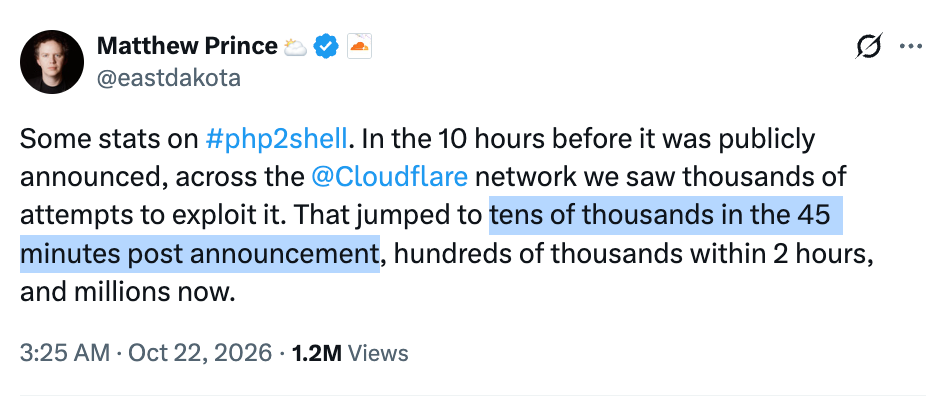
AI models including OpenAI's GPT-5.6 Sol are enabling both security researchers and attackers to find and exploit CVEs at scale, with nontechnical actors now capable of launching sophisticated attacks. This week alone saw breaches at Railway, TiDB (10TB of customer data including from Booking.com, Airbnb, Databricks), eMudhra CA, and multiple critical CVEs in PHP, Node.js, GitLab, and Linux, with exploit attempts beginning hours after patches were released.

Worth Reading

Coordinated Disclosure of Critical Vulnerabilities: OpenAI's Patch the Planet Framework and PHP Zero-Days

OpenAI

OpenAI published a release on coordinated vulnerability disclosure and its Patch the Planet initiative. Main takeaways:

  • OpenAI's GPT-5.6 Sol identified critical PHP vulnerabilities before attackers, establishing a "Defender's Window" for maintainers to prepare fixes ahead of public disclosure
  • OpenAI committed $1 billion in subsidized Daybreak access for frontline defenders with limited security resources, plus funding and model access to open-source maintainers
  • Proposed five-stage framework for critical vulnerability response: validate/fix upstream, give organizations time to act, coordinate with government partners (White House, CISA, ONCD), prepare updates across products, and publish guidance post-patch
  • Frontier AI capabilities now expected to discover vulnerabilities at internet scale, with OpenAI anticipating "similar findings to increase sharply in the coming months"
  • Framework addresses disclosure windows, emergency patching authority, staged notifications, and secure-by-default software design as open questions for security community input
Read more

This Week in Markets 10/30/2027

Artemis Analytics

Artemis Analytics published a markets report covering Anthropic's S-1 filing, Google's earnings miss, and emerging tokenized equity dynamics. Main takeaways:

  • Anthropic's ~900% NRR is 6x the best software IPO; 1,088% YoY revenue growth would be largest for large-cap tech IPO; both Anthropic and OpenAI have eclipsed $50B ARR
  • Google search revenue growth decelerated from +16.8% (Q2) to +12.0% (Q3), missing analyst expectations of 13-14%; stock fell 12% on uncertainty about AI monetization and 2027 CapEx guidance
  • Google disclosed utilizing third-party compute capacity end-of-Q3 with margin headwinds; expects CapEx to increase significantly in 2027 beyond $195-205B 2026 guidance
  • Tokenized equity market cap reached 2x stablecoin supply 16 months after $1M threshold; Binance captured top spot in spot trading with $3B weekly volume after June launch
Read more

Was I Wrong About Open Models and Cyber Risks?

Interconnects

Interconnects published an essay reconsidering claims about open-weight model cyber risks in light of recent vulnerability disclosures and actual attack patterns. Main takeaways:

  • Claude Mythos (April 2026) was presented as catastrophic if released open-weight, but GLM-5.3 (August 2026) appears to be the actual threshold model for serious cyber exploitation, suggesting earlier threat assessments were overstated
  • Closed-weight models have been documented in more actual cyber attacks than open-weight models to date, contradicting the narrative that open models are the primary cyber risk vector
  • Open-weight models may provide defensive balance by enabling security teams to patch vulnerabilities before attackers can exploit them, particularly for air-gapped critical infrastructure
  • The patch-gap exploit research (Firefox compromises costing ~$1,000 per version using GLM-5.3) demonstrates real but contained risk requiring multi-stage attack chains, not infrastructure-crippling capability
  • Frontier labs' competitive incentives to demonize open models, combined with classification barriers preventing public assessment of actual threat data, have distorted policy discourse
Read more

Big Tech Holds $3 Trillion in Spending Commitments for AI Boom

Bloomberg

Bloomberg reported on the aggregate capital commitments of the five largest tech companies (Alphabet, Meta, Microsoft, Amazon, Oracle) for AI infrastructure buildout. Main takeaways:

  • Combined $3+ trillion in disclosed spending commitments across data centers, leases, energy, and equipment over coming years
  • Capital spending doubled to $556.9B in first nine months of 2026, exceeding operating cash flow for first time since at least 2011
  • Free cash flow turned negative ($14B deficit vs. $143.5B surplus year-over-year) as capex now exceeds cash generation
  • Buybacks collapsed 83% to $13.6B while dividends held at $37B, signaling prioritization of infrastructure over shareholder returns
Read more

Articles Read