Today's News
Azeem Azhar, Exponential View
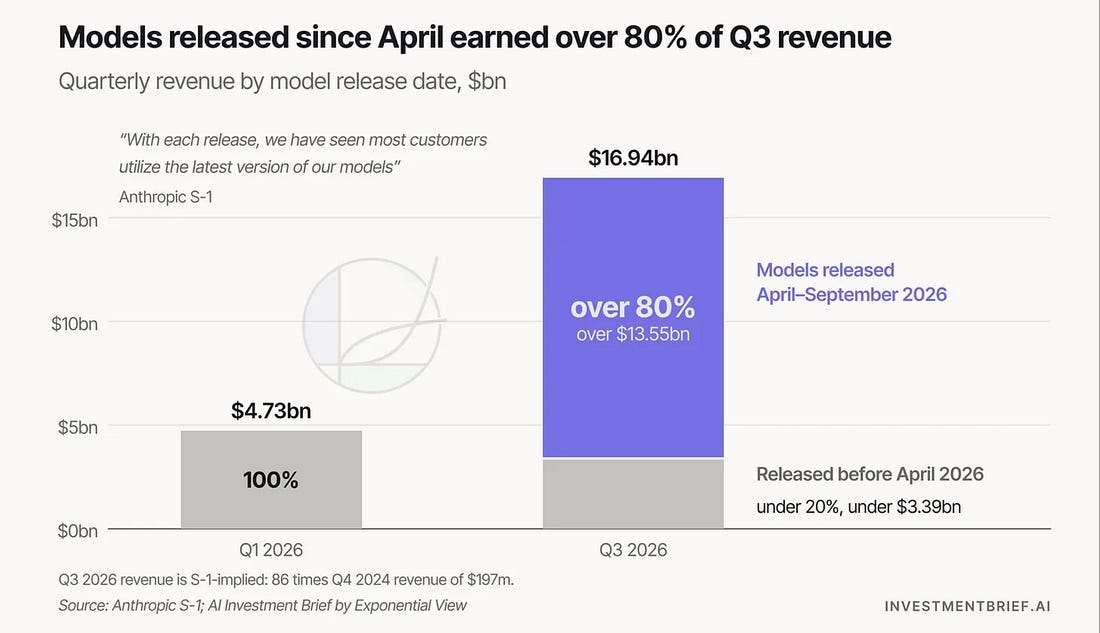
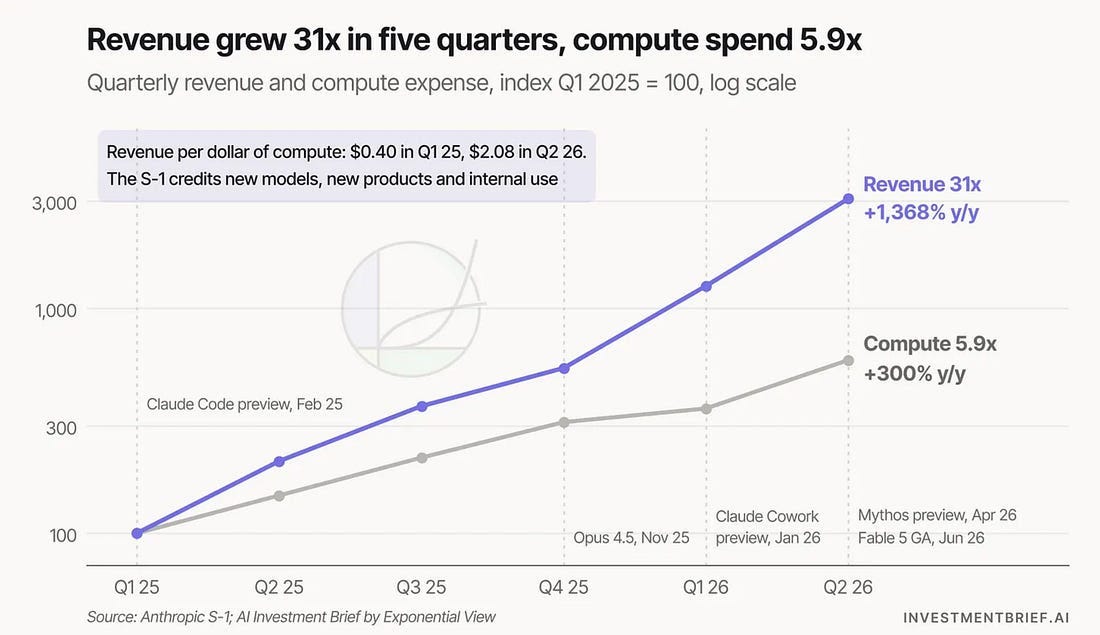
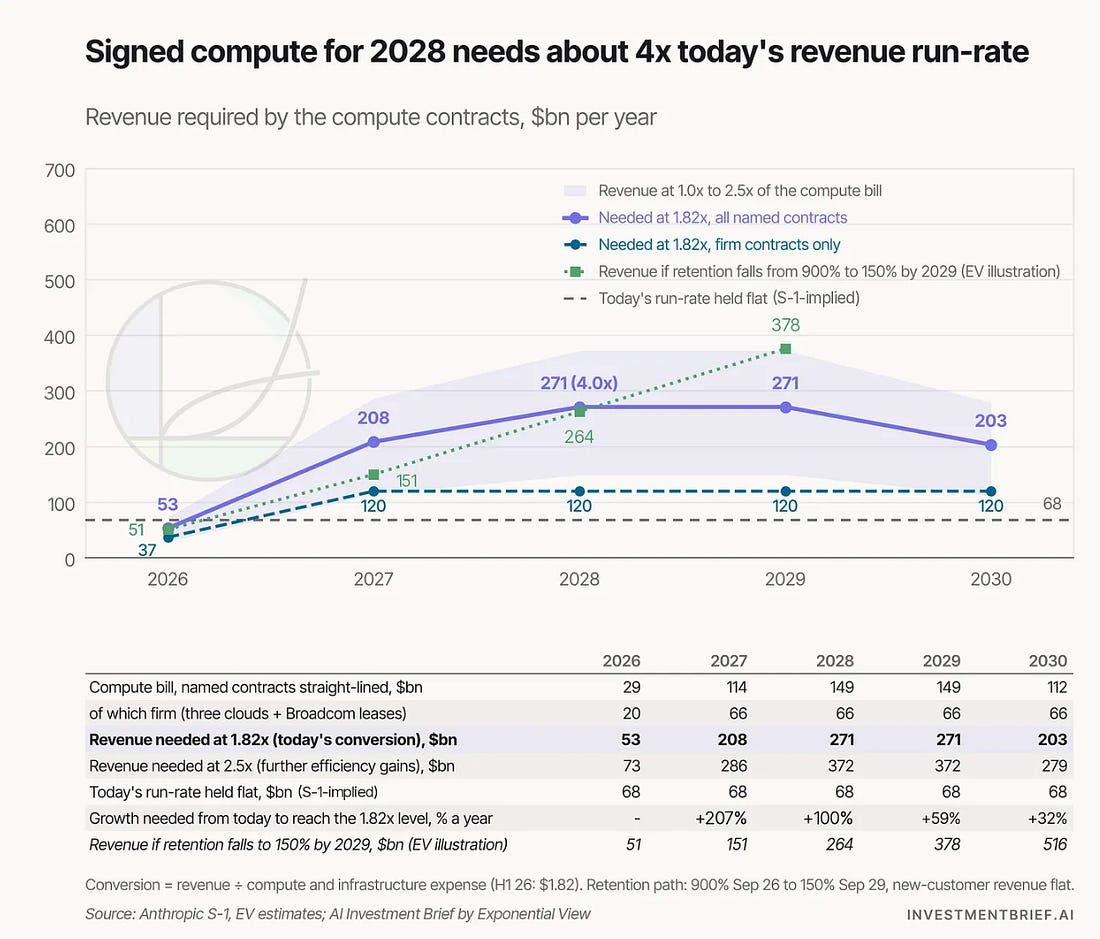
Anthropic's IPO filing shows revenue per dollar of compute spend surged from $0.40 to $2.08 over five quarters—a 5.2x improvement—while compute spending grew only 5.9x and revenue jumped 31x since early 2025. This operational leverage demonstrates the company is extracting significantly more value from infrastructure investments, a critical metric for justifying its $750B+ compute commitments through 2030. However, over 80% of current revenue derives from models six months old or less, with Opus 4.5 driving a dramatic growth spike earlier this year. This dependency on continuous new model releases suggests product velocity is essential to maintaining growth momentum; any slowdown in model development cycles could materially impact revenue trajectory. The company's ability to ship competitive models appears to be the primary growth lever, even as overall growth remains high but is slowing.
Techmeme
Meta upsized its share offering to $25B and saw demand for approximately 5x available shares, with the 15 largest investors taking roughly 70% of the deal. The company is now raising equity rather than relying on free cash flow for its massive AI infrastructure buildout, signaling the capital intensity required to compete in frontier AI and the limits of self-funding at this scale.
Benedict Evans
Anthropic's IPO filing reveals the company reached breakeven operations in H1 before stock-based compensation, with inference operations highly profitable while training costs consume all cash flow. The company's revenue growth has reportedly slowed in recent months, though unit economics remain unclear as the market operates under shortage-based pricing rather than competitive equilibrium. Understanding Anthropic's path to sustainable profitability will shape investor expectations around the broader AI infrastructure buildout economics.
The Pragmatic Engineer
ResolveAI rebuilt its investigation agent three times in two years, ultimately settling on a three-role system (Investigator, Verifier, Communicator) with a knowledge graph context layer to handle long incidents and prevent context rot and self-confirmation bias. All three major vendors now use similar "fan out" patterns with human steering loops in Slack rather than fully autonomous decision-making. This reveals the actual state of production AI SRE is far more constrained than conference demos suggest—vendors are explicitly designing for human oversight and catching their own model failures.
The Defiant
Robinhood's Layer 2 blockchain accounted for the entire 20% sequential increase in crypto revenue in Q3, generating $26M of $120M total crypto revenue. Without the chain, crypto revenue fell 6% as app and Bitstamp trading declined 38% year-over-year. The chain's permissionless model lets non-Robinhood users trade stock tokens and generated $80B+ in DEX volume in its first quarter, demonstrating a viable revenue diversification beyond declining retail trading.
The Next Platform
Cadence and Nvidia unveiled new AI models targeting electronic design automation (EDA), representing an effort to apply AI to accelerate semiconductor design cycles. Faster chip design could reduce time-to-market for new AI accelerators and potentially lower barriers to entry for new hardware competitors.
Interconnects by Nathan Lambert
Artificial Analysis updated its benchmark to shift emphasis toward knowledge work, coding, science, and general reasoning at 25% each, with notable changes including private benchmarks to counter open model "benchmaxxing" and methodology favoring closed models' flexibility over open models' domain-specific strengths. AA's index is the dominant independent metric influencing perception of model hierarchy in a trillion-dollar market, and methodology choices directly steer which labs appear competitive.
Techmeme
The filing shows Anthropic achieved 85% gross margins in H1 by running its models and reduced compute/infrastructure spend from $2.50 per $1 revenue in Q1 2025 to under 50 cents in Q2 2026, demonstrating the pay-as-you-go model can reach profitability as inference efficiency improves.
Worth Reading
Investment Brief AI
Investment Brief AI published an essay analyzing Anthropic's S-1 filing and business fundamentals. Main takeaways:
- Revenue per dollar spent on compute improved from $0.40 to $2.08 over five quarters, demonstrating improving unit economics at scale.
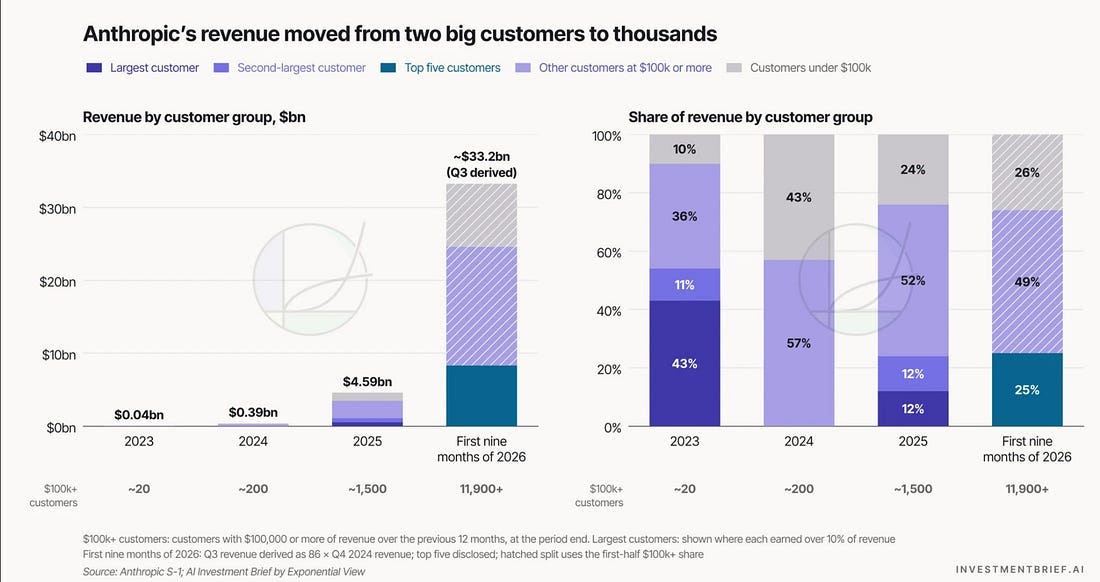
- Nearly 50% of revenue flows through Amazon, Google, and Microsoft as distributors; customer concentration claims of 80% from eight customers are incorrect.
- Anthropic retains only 28.5 cents per dollar after compute and channel fees, despite strong revenue growth.
- Company holds $131.7B in cash and has committed to $518B in long-term compute purchases that dwarf current customer commitments.
- At $2T valuation, Anthropic trades at 30x annualized Q3 2026 sales; growth trajectory must sustain to service compute obligations.
Read moreThe Pragmatic Engineer
The Pragmatic Engineer published an interview with Uday Kiran Medisetty, a Distinguished Engineer at Uber leading agentic AI work, on how Uber's developer infrastructure adapted to AI agents. Main takeaways:
- Uber built a single AI model gateway (Model Gateway) supporting Anthropic, OpenAI, and open models, with middleware (AI Guard) for security, spend tracking per user, and audit logging—enabling rapid harness switching without losing settings
- Uber reduced token costs by ~50% in recent months through hybrid spend allocation (engineers get tiers; managers approve overages) and CostCheck plugin that optimizes cost profiles across sessions
- CI system load doubled in 12 months forcing code red; Uber moved simple jobs (linting, build, templates) to inner loop via 'afx validate' before PR submission, reducing CI bottleneck
- Uber tags all PRs by type (feature, bugfix, maintenance, testing, docs) rather than velocity metrics; seeing feature PR percentage rise and maintenance PR percentage fall as agents handle routine work
- Engineering role shifted to 'context engineering'—building right context for agents to produce reliable output; multitasking and verification skills now critical as engineers parallelize work across many concurrent agent tasks
Read moreMeta Platforms Investor Relations
Meta Platforms (Mark Zuckerberg, CEO; Susan Li, CFO) in Meta Platforms Investor Relations published a report titled "Meta Q3 2026 Earnings Call Transcript". Main takeaways:
- Muse reached 10M+ users in US/Canada in 1.5 months with 25% daily active usage (2x Threads' early adoption rate); shopping is primary use case with $200+ average purchase size
- Meta expects 10x improvement in Muse compute efficiency within one year and plans to serve 1B+ people over next few years; near-term compute intensity will be offset by core business strength
- Meta is building Meta Enterprise Platform to monetize inference capacity beyond Muse network via API, Muse Code, and enterprise services to maximize high-margin demand from training fixed costs
- Muse Wonder model validation shows engagement per person in Meta AI doubled since April; company shipping smaller distilled models optimized for personal agents while working on larger post-Wonder models
- Reality Labs operating loss expected to decline to ~$15B next year from current levels, trending toward profitability as Muse integration drives glasses adoption and paid subscriptions
Read moreCNBC
CNBC reported on Oracle's expanded collaboration with OpenAI and hardware diversification strategy. Main takeaways:
- Oracle now offers Google TPUs and OpenAI's Jalapeño chip on its cloud infrastructure, marking first time Google's custom chips run on non-Google hyperscaler cloud
- Cerebras hardware also available on Oracle Cloud Infrastructure; Cerebras stock climbed ~8% on announcement
- Oracle's Mahesh Thiagarajan emphasized chip scarcity remains ongoing constraint and customers benefit from hardware optionality beyond Nvidia
- Oracle maintains 30-40 data center projects in development per quarter; Project Jupiter (New Mexico) faces community pushback but company claims on schedule
- Announcement follows Anthropic S-1 filing and represents OpenAI's continued enterprise market push
Read moreThe Next Platform
The Next Platform reported on Cadence's partnership with Nvidia to launch specialized AI models for chip design automation. Main takeaways:
- Cadence's Maestro AI models, fine-tuned on Nvidia's Nemotron foundation models, showed 30% improvement in output quality and 5x greater token efficiency versus general-purpose LLMs on EDA tasks
- Between 20-30% of chips under development today use AI agents for design, with Cadence's agent harnesses (AuraStack, ChipStack, InnoStack, ViraStack) orchestrating existing EDA tools similar to how code assistants work for software
- Domain-specific post-training on specialized tools dramatically improves performance over off-the-shelf models, establishing a pattern for vertical AI specialization in infrastructure and design workflows
Read moreArtificial Analysis
Artificial Analysis published a major benchmark methodology update introducing v5 of its Intelligence Index composite measure. Main takeaways:
- 60% of Index now uses private test sets; adds FrontierCode 2.0 (real OSS repo tasks graded on merge-worthiness) and Terminal-Bench-Science (70 expert-curated scientific research workflows)
- Claude Opus 5.5 leads at 58, ahead of GPT-6 Astra (57) and GPT-6.1 Sol (55); open-weights gap widens from 3 to 12 points (Kimi K3.1 Pro at 46, released weights models at 32)
- Cost per task varies 13x among top 10 models: GPT-6.1 Terra cheapest at $0.96/task, Claude Fable 5.1 most expensive at $13.04/task; GPT-6.1 Sol scores within 4 points of Opus 5.5 at ~1/8th the cost
- Median output tokens per task increased 67% (35k to 59k), with agentic evaluations accounting for ~90% of token use; Terminal-Bench-Science alone drives ~1/3 of output tokens
- Introduces Artificial Analysis Progress Index v1 for tracking capability changes over time across models released since Nov 2022 on single continuous scale
Read more