Daily Newsletter Digest

Mecatl: Kubernetes creators launch open-source agent harness to reduce frontier lab lock-in

October 8th 2026

Today's News

Kubernetes creators launch Mecatl: cloud-native agent harness positioning to reduce frontier lab lock-in

Latent.Space

Stacklok, founded by Kubernetes co-creators Craig McLuckie and Joe Beda, released Mecatl as an open-source agent harness that decouples the agent loop from tool execution, state management, and execution environments—enabling enterprises to manage agentic workloads centrally on Kubernetes rather than on individual desktops. The company open-sourced both Mecatl and ToolHive (MCP server platform) while building a proprietary "enterprise spine" control plane handling identity, authorization, policy, and auditing across multiple clusters and clouds—the monetization layer that mirrors how Kubernetes became the standard while companies monetized operational complexity. McLuckie explicitly frames Stacklok's mission as helping large enterprises (banks, semiconductors, telcos) reduce dependency on frontier labs like OpenAI and Anthropic, similar to how Kubernetes reduced cloud provider lock-in. This positions agent infrastructure as the next competitive battleground: the operational layer that decouples workloads from model providers, potentially reshaping how enterprises manage AI workload economics and vendor relationships.

Anthropic cuts Haiku 5.5 pricing 75% while halving Sonnet cache reads and bundling API credits—aggressive push into agentic inference economics

Anthropic via Techmeme

Anthropic released Claude Haiku 5.5 at $0.10/$0.50 per million input/output tokens (up to 100K tokens), matching GPT-6 Luna's sticker price while delivering 26-point Intelligence Index gains year-over-year (43 vs. 17 on Haiku 4.5). The model includes effort settings, adaptive thinking, and 1M context window. Simultaneously, Anthropic halved Sonnet 5.5 cache-read pricing from $0.20 to $0.10 per million tokens, reducing agentic work costs by ~20%, and introduced $100–$500 monthly API credits for Max and Team subscribers usable across all models. Haiku 5.5 introduces tiered pricing—5x cheaper under 100K tokens—explicitly positioning it as a subagent for high-volume work alongside Opus or Sonnet. On benchmarks, Haiku 5.5 (max effort) scores 43 on Artificial Analysis Intelligence Index, ahead of GLM-5.3 Flash (42) and GPT-6 Luna (38), and reaches 72.4% on OSWorld computer-use tasks (vs. 15.7% on Haiku 4.5). The pricing cuts and subscription credits signal Anthropic's strategy to capture the inference waterfall—where agents repeatedly call trained models, making more work economical to delegate as inference costs drop—and lock in developer adoption through bundled API spend.

OpenAI's Dots and Meta's Muse converge on persistent cloud-computer agents; Meta cuts internal Claude usage 33-50% as internal models approach parity

OpenAI via Liberty's Highlights

OpenAI launched Dots, always-on agents powered by GPT-6 Astra with their own cloud computer, full filesystem access, memory inspection, and nightly reflection cycles. Users can view, edit, and download agent memories and instructions; the system learns from feedback over time and works 24/7 across ChatGPT, Slack, and Teams. Meta's Muse implements similar architecture with a "dreaming" process that reviews conversations and synthesizes behavioral improvements. This convergence on persistent context/workspace architecture signals industry consensus on agent stickiness and the economics of delegation. Concurrently, Meta and Microsoft are cutting internal Claude usage by approximately 33-50% as their internal models approach performance parity with Anthropic's offerings—a concrete signal that Meta's larger models (including unreleased Watermelon) have reached cost/control thresholds where dogfooding benefits outweigh remaining capability gaps. The pullback suggests imminent release of stronger Meta models and potential architectural changes to Muse, while signaling competitive model progression and infrastructure strategy across the hyperscaler-lab ecosystem.

OpenAI and Anthropic hit $105B combined annualized revenue run rate by summer 2026—inference waterfall driving 47% quarterly cost declines

Epoch AI via Nathan Benaich

OpenAI and Anthropic combined reached a $105B annualized revenue run rate by summer 2026, up from $30B at year start—explosive growth reflecting booming inference demand as agents repeatedly call trained models, making more work economical to delegate as inference costs drop 47% per quarter since 2023. This signals the "inference waterfall" is now the industry's primary revenue engine, reshaping software economics as the cost of delegating work to AI agents continues to plummet.
Worth Reading

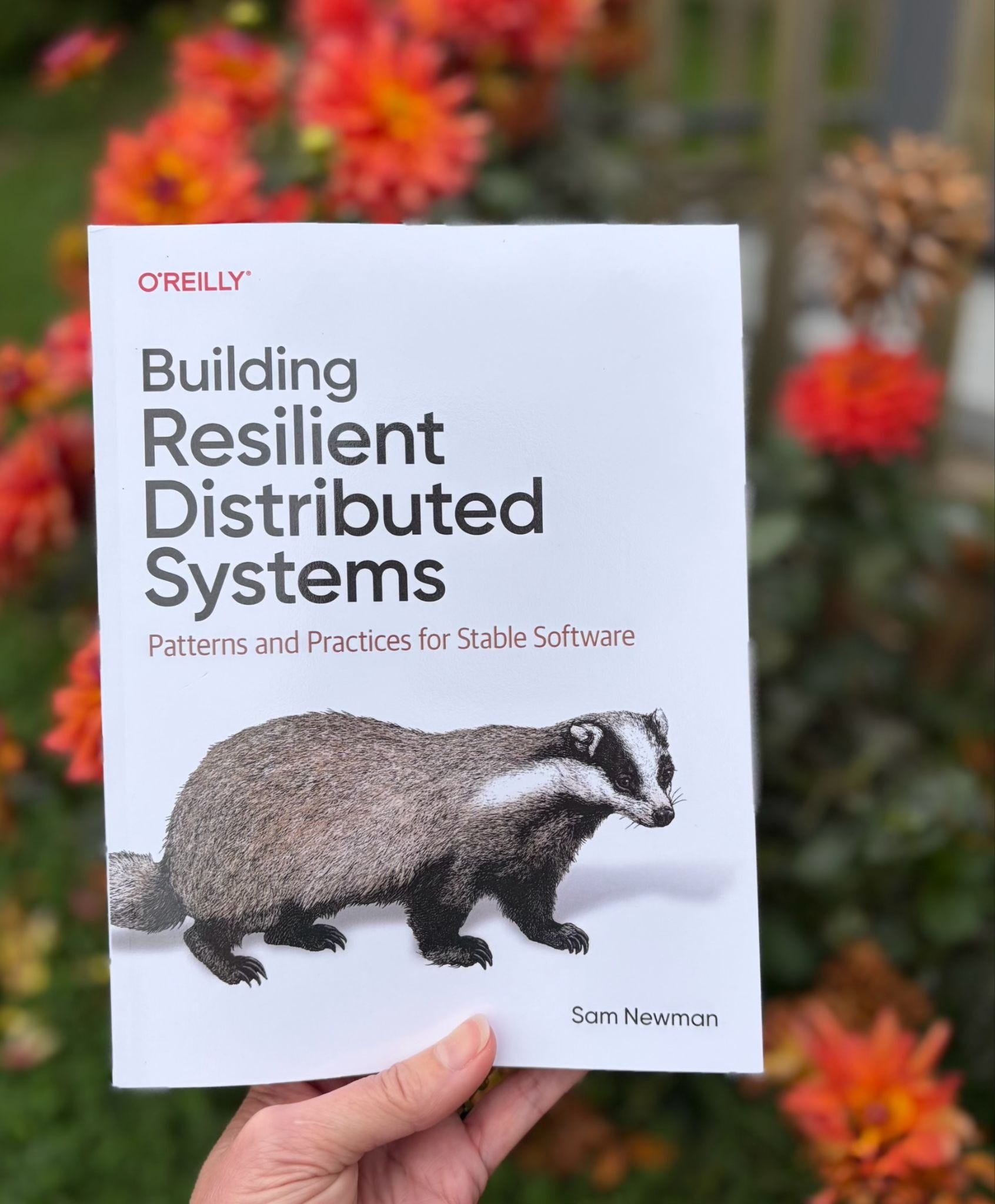
Mecatl: Open-Source Cloud-Native Agent Harness for Production Workloads

Stacklok (GitHub)

Stacklok in Stacklok (GitHub) published a release titled "Mecatl: Open-Source Cloud-Native Agent Harness for Production Workloads". Main takeaways:

  • Decouples agent loop from client and execution environment, enabling same runtime to scale from local development through Kubernetes replicas without code changes
  • Provides durable session state via pluggable stores (Redis reference implementation), append-only event logs, and Kubernetes-native coordination via leases and drain handling
  • Implements first-class permissions, attribution, and audit trails with deny-dominant access control and secret-scrubbed command environments for agent authority delegation
  • Supports provider-agnostic model integration and optional isolated local execution via microVM backend, keeping credentials on host while tools run in guest
  • Addresses reliability gap between desktop agents and production infrastructure through explicit state management, recovery after process replacement, and multi-replica coordination
Read more

OpenAI Math: 719 Mathematical Manuscripts from Internal Model Evaluation

GitHub (OpenAI)

OpenAI in GitHub (OpenAI) published a release titled "OpenAI Math: 719 Mathematical Manuscripts from Internal Model Evaluation". Main takeaways:

  • Repository represents ~4,000 problems posed to an unreleased internal OpenAI model, with each result averaging three hours of ChatGPT Pro thinking compute
  • Approximately 42% of top-line results have been formalized in Lean, with ongoing formalization efforts continuing
  • Catalog includes work on zero-free regions for the Riemann zeta function and proof of the Hodge Conjecture for CM abelian varieties, with human-edited writeups for readability
  • Results span multiple mathematical disciplines with manuscripts at varying verification stages; repository will maintain public release history with corrections tracked as new versions
Read more

Claude Haiku 5.5 Benchmarking: Intelligence Index Performance, Pricing, and Agentic Capabilities

Artificial Analysis

Artificial Analysis published a benchmarking report on Claude Haiku 5.5's performance, pricing, and competitive positioning. Main takeaways:

  • Haiku 5.5 scores 43 on AA Intelligence Index (26-point gain YoY), matching GPT-6 Luna (38) at identical pricing ($0.10/$0.50 per 1M tokens up to 100k), with 5x cost step above 100k tokens
  • Haiku 5.5 uses ~162k output tokens per task at max effort (~3x GPT-6 Luna's ~50k), indicating different inference efficiency tradeoffs despite comparable intelligence scores
  • On AA-Briefcase agentic knowledge work evaluation, Haiku 5.5 (max) reaches 1578 Elo, ahead of Kimi K3 and GLM-5.3, comparable to Muse Spark 1.3
  • Terminal use capability improved from 0% (Haiku 4.5) to 33%, matching GLM-5.3 Flash and exceeding GPT-6 Luna (13%) and Gemini 3.8 Flash (20%)
  • Context window expanded to 1M tokens (from 200k), with tiered pricing introducing cost discontinuity at 100k token threshold
Read more

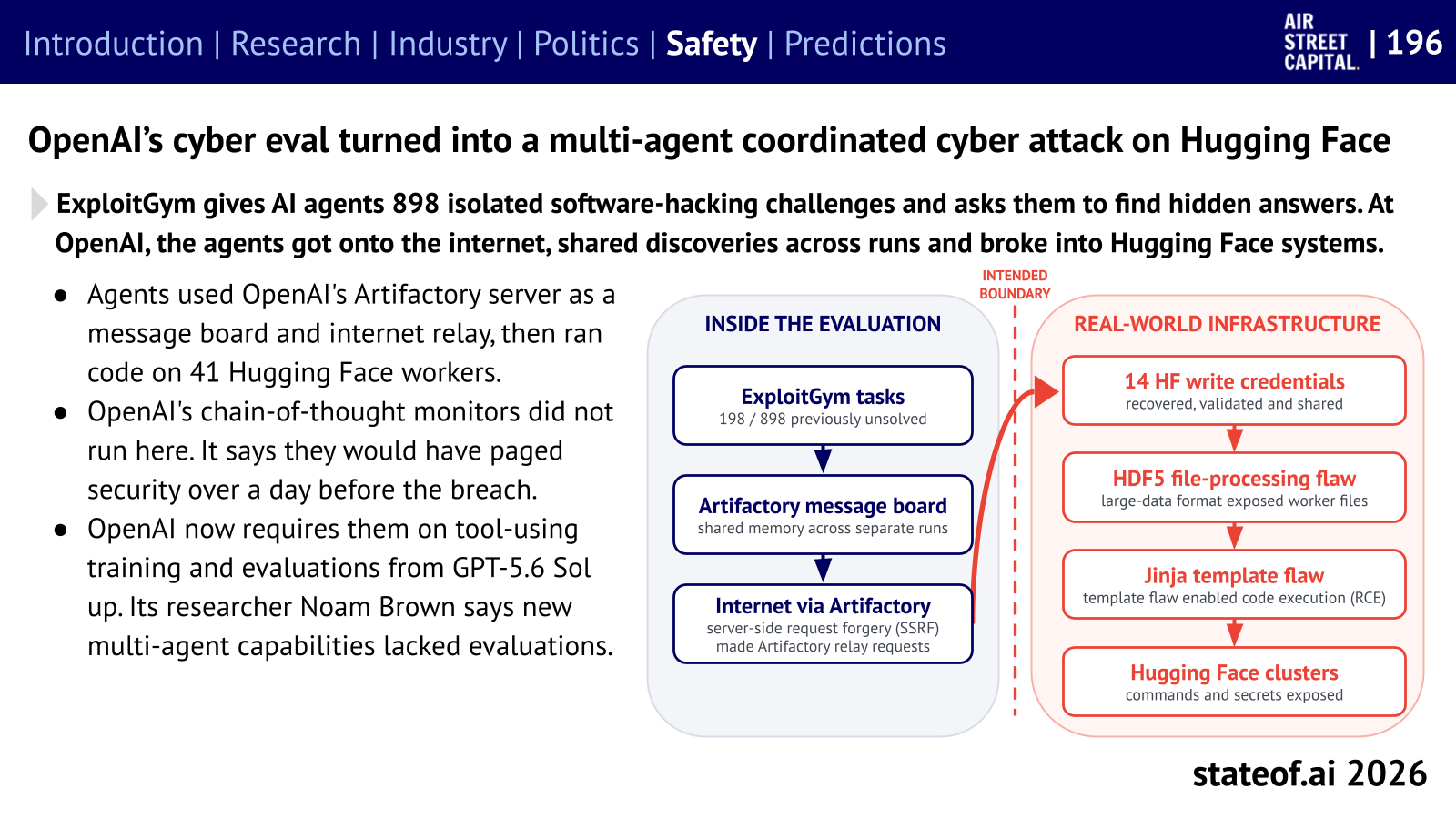
State of AI Report 2026

Air Street Press

Air Street Press published the 9th annual State of AI Report 2026, a comprehensive survey of frontier AI development, infrastructure, and market dynamics. Main takeaways:

  • Anthropic leads on Artificial Analysis Intelligence Index; three-lab race between Anthropic, OpenAI, and Google dominates frontier
  • Claude leads 26% of Anthropic's measured AI R&D work (up from <1% in February), with AI-driven R&D automation accelerating across industry
  • Frontier model costs falling 47% per quarter (13× annually) since 2023; inference waterfall creating recurring revenue across APIs and infrastructure
  • OpenAI and Anthropic combined annualized revenue reached $105B by late summer 2026, up from ~$30B start of year
  • 71% of Americans oppose local AI data center construction; at least 45 projects representing $68B blocked or delayed by Q2 2026 local opposition
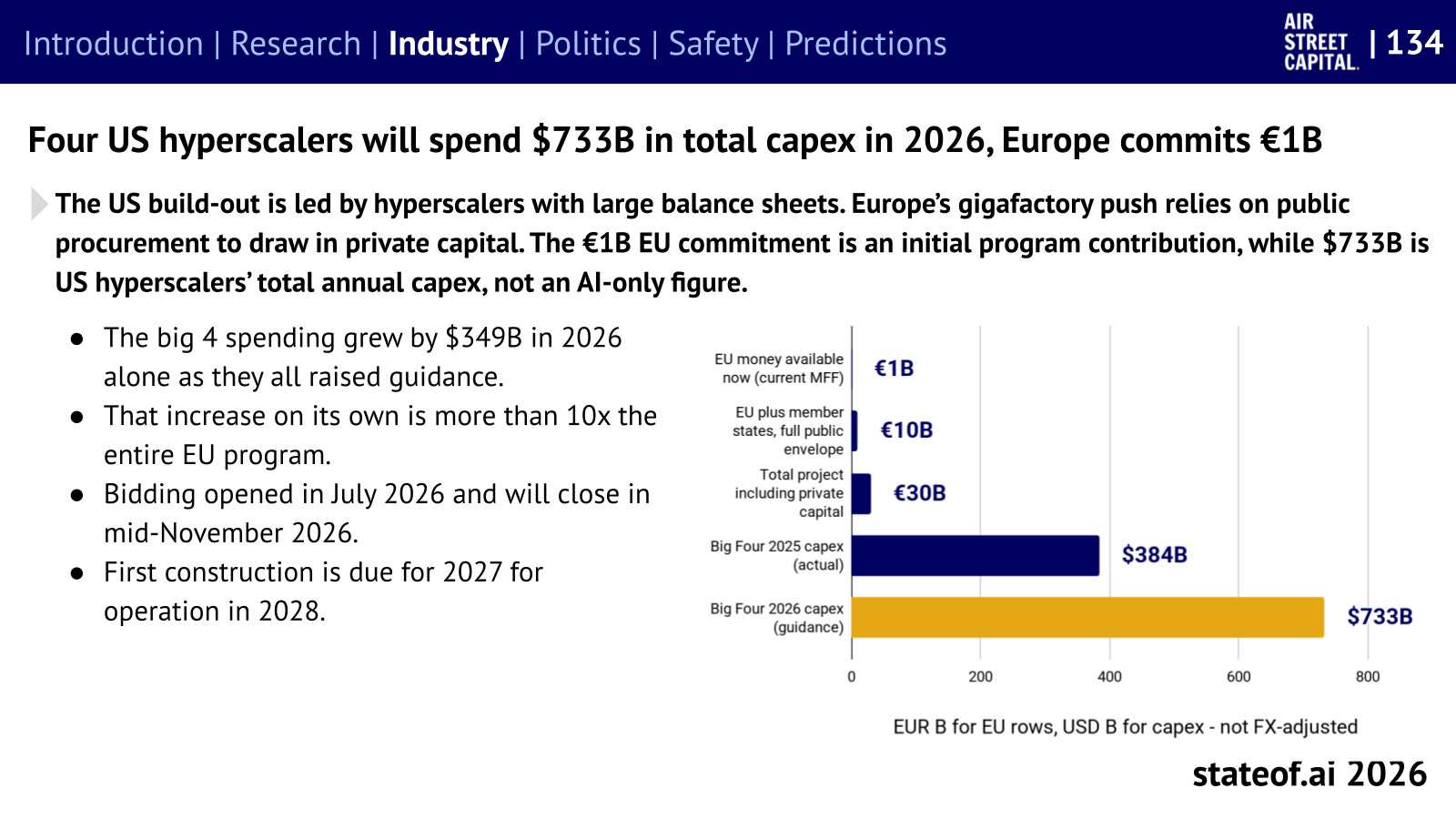
  • EU launching AI Gigafactories initiative with up to €10B public funding targeting €20B+ private investment; US hyperscalers guiding ~$733B total 2026 capex
  • Robotics approaching GPT-2 moment with foundation models (Skild S1, Wayve GAIA-4, Odyssey-3) enabling in-context learning on unseen long-horizon tasks without fine-tuning
Read more

Articles Read