Today's News
Reuters via Techmeme
Broadcom has agreed to lend Anthropic up to $42 billion via convertible notes to finance roughly one-third of a $125.2 billion five-year commitment for Google TPU computing capacity, according to Anthropic's IPO filing. The arrangement locks Anthropic into massive compute demand while making it Broadcom's largest customer in its chip design business by 2027—a relationship that spans compute supply, equipment leasing, and financing. Anthropic disclosed potential conflicts of interest, warning that Broadcom's pricing and hardware decisions could affect its ability to procure sufficient computing infrastructure, and that certain payment defaults could make lease obligations immediately due while limiting access to the financing facility. The deal mirrors Nvidia's strategy of using its balance sheet to boost chip sales and signals the reciprocal spending dynamics that have animated AI skepticism on Wall Street, even as Anthropic targets an IPO valuation near $2 trillion.
Rails World keynote via The Pragmatic Engineer
Ruby on Rails creator David Heinemeier Hansson announced at Rails World 2026 that 37signals has stopped writing code by hand for professional work, treating manual coding as an exception requiring investigation. The 27-year-old profitable software company is now building native mobile apps (reversing its historical web-first stance), moving backend services to Rust, and relying on AI agents for primary development. This represents a significant signal from a company historically known for code quality and disciplined engineering, suggesting that AI-driven development has crossed a threshold where established software firms are restructuring their entire technical strategy around agent-based workflows rather than treating AI as an augmentation tool.
Vercel AI Gateway / TypeSafe via Clouded Judgement by Jamin Ball
OpenAI, Databricks, and Perplexity all launched decision model offerings this week, positioning this category as a potential next wave after frontier and open-weight models. Decision models are 100x+ cheaper than frontier models while potentially handling 10-15% of current token volume through specialized classification and routing tasks, making them economically significant for the AI stack.
Artificial Analysis via AINews
OpenAI's GPT-6.1 Sol achieves a 30% cost reduction versus GPT-6 Sol ($0.72 vs. $1.04 per task) primarily through improved cache reads and fewer conversation turns rather than raw token efficiency improvements, according to Artificial Analysis benchmarking. At maximum effort, GPT-6.1 Sol costs less than a quarter of GPT-6 Astra ($0.72 vs. $3.26) and 64% less than GPT-5.6 Sol ($1.99), pushing out the cost-efficiency Pareto frontier across all effort levels. The shift signals OpenAI's focus on inference efficiency and cost-per-task metrics as competitive vectors beyond raw model capability.
Alex Zhang via Latent.Space
MIT researcher Alex Zhang discusses Recursive Language Models (RLMs) as the next architectural frontier, enabling models to treat their own prompts as objects in external memory for self-improvement and context offloading. An RLM-based harness was the first to solve ARC-AGI-3 before OpenAI's Astra, and the approach is spawning follow-on research like Context Language Models that give models unrestricted control over context management. This signals a shift in how frontier labs are architecting agent systems and harnesses rather than focusing solely on scaling model parameters.
Upstage via AINews
Google released Gemini 4 Argon with revised pretraining and long-horizon post-training; Black Forest Labs launched FLUX 3 with native 4K generation and multi-image reference support; and Upstage released Solar Mini 4 (3B active parameters, 1M context window) at $0.10/$0.40 per-token pricing. Solar Mini 4 scores 24 on Artificial Analysis's Intelligence Index and achieves a new Pareto optimal point for models under 3B active parameters, with particular strength in long-context reasoning (83% on AA-LCR v1.1) but relative weakness in agentic coding (1% on Terminal-Bench 4.0). The rapid release cadence and pricing pressure across modalities underscore intensifying competitive dynamics in frontier AI.
Arc Portal via Today in DeFi
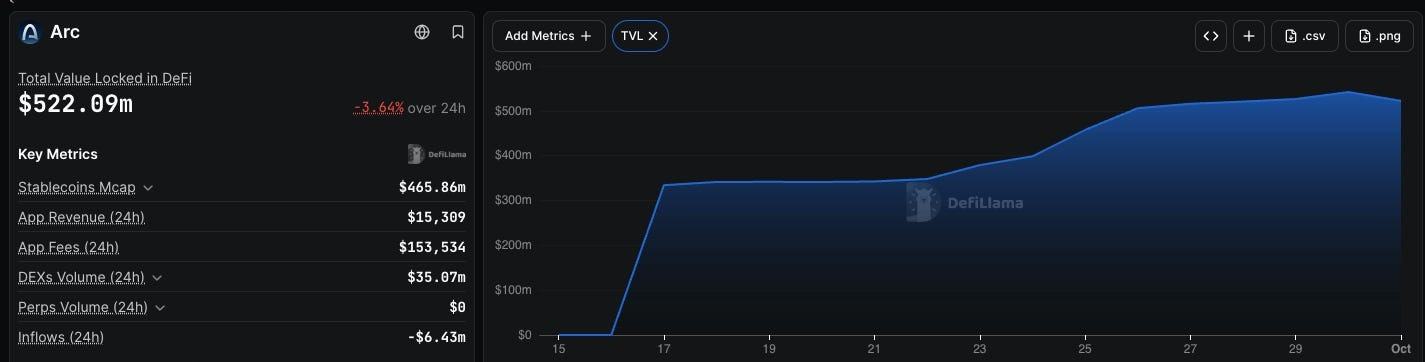
Arc's initial casino phase (83K tokens launched day one) rapidly gave way to real credit demand, with $175M borrowed against bitcoin at near-zero rates on Morpho and institutional yield vaults already operational. This concrete shift from speculation to credit markets demonstrates product-market fit for institutional DeFi primitives.
SpaceX via Not Boring
On its 14th flight attempt, Starship achieved orbital velocity, released 26 Starlink V3 satellites, and demonstrated engine control to leave orbit before splashing down in the Pacific. This marks a critical inflection point for rapid reusability and cost reduction in launch infrastructure.