Today's News
Ornn via Data Gravity by Chris Zeoli
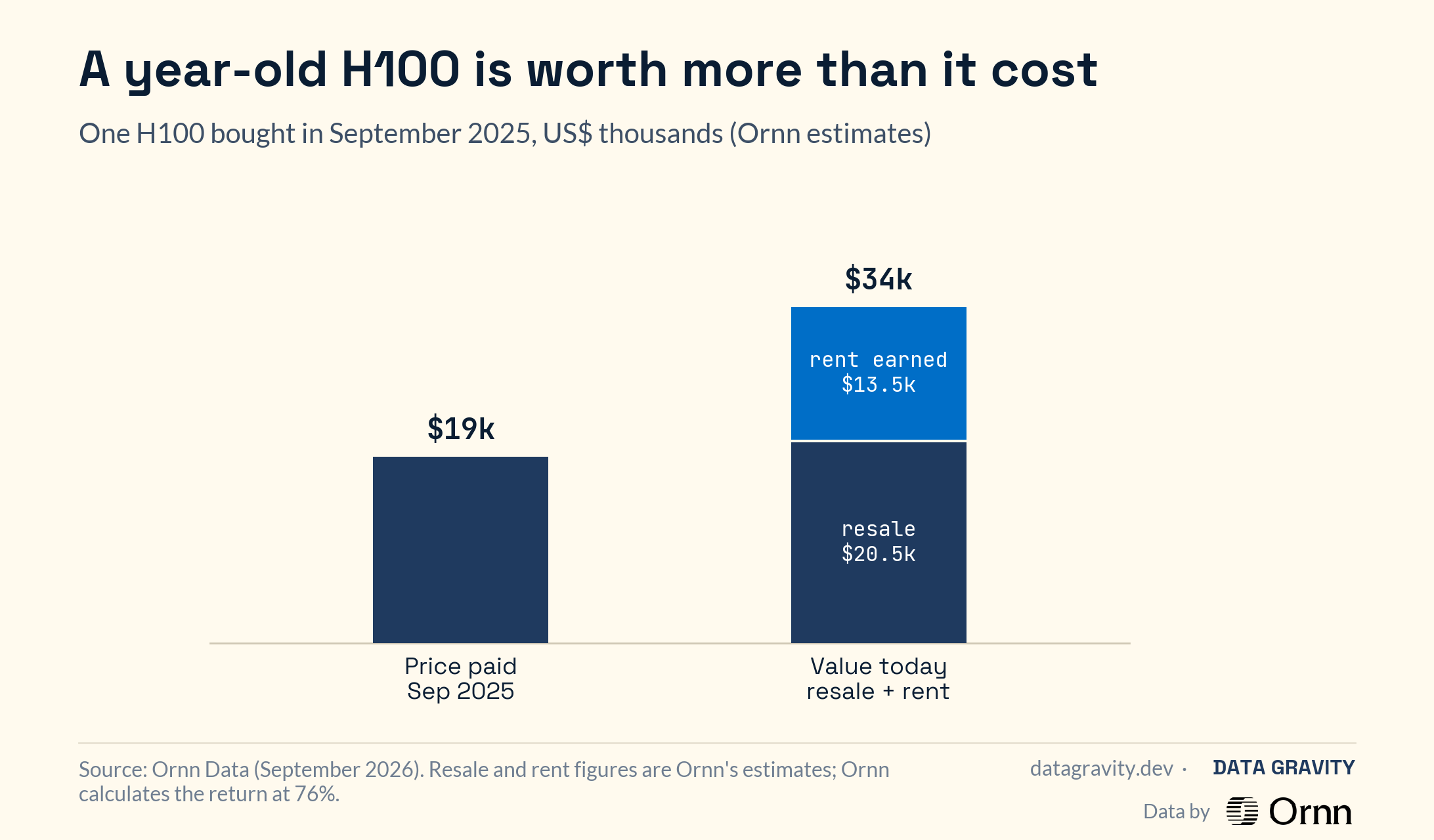
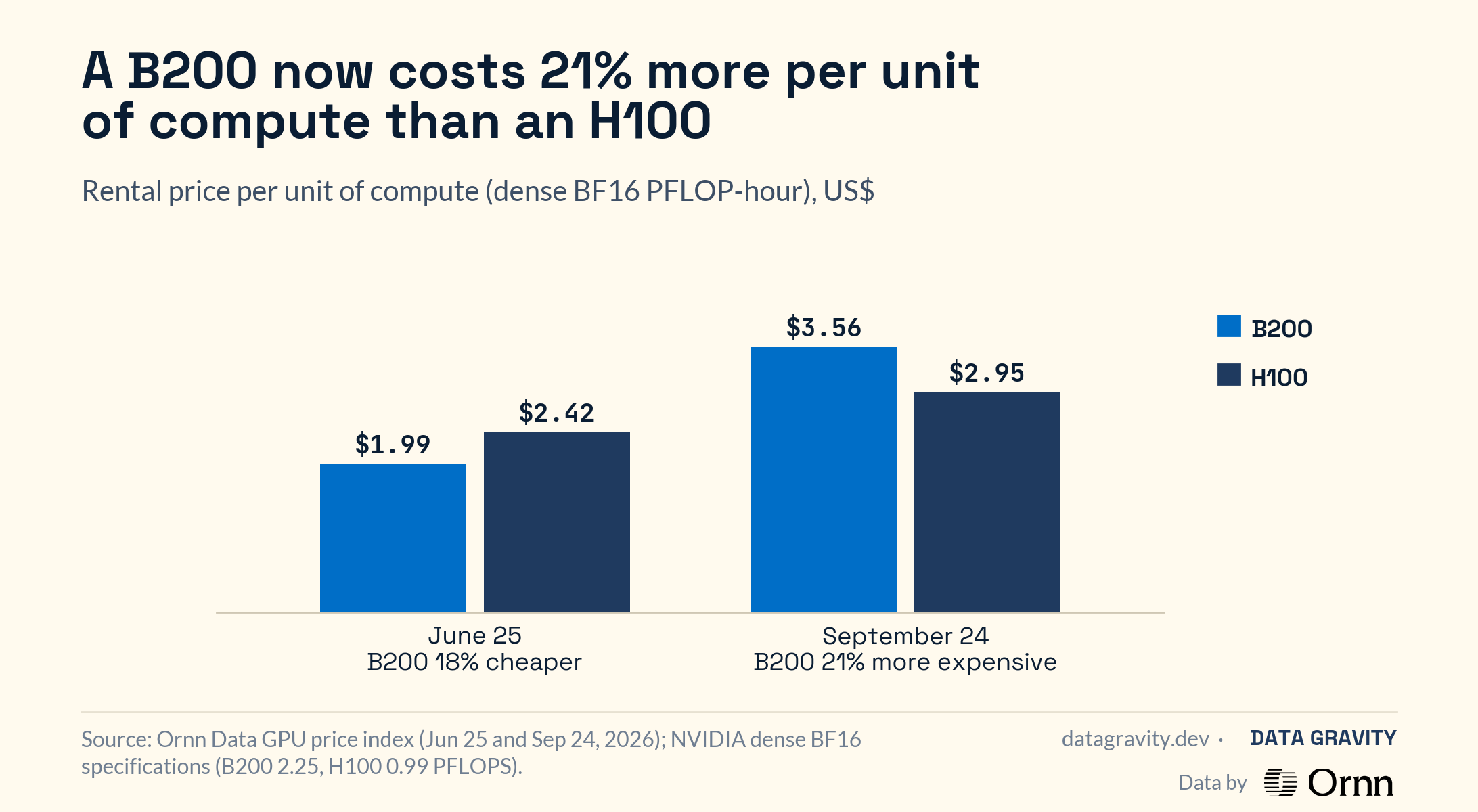
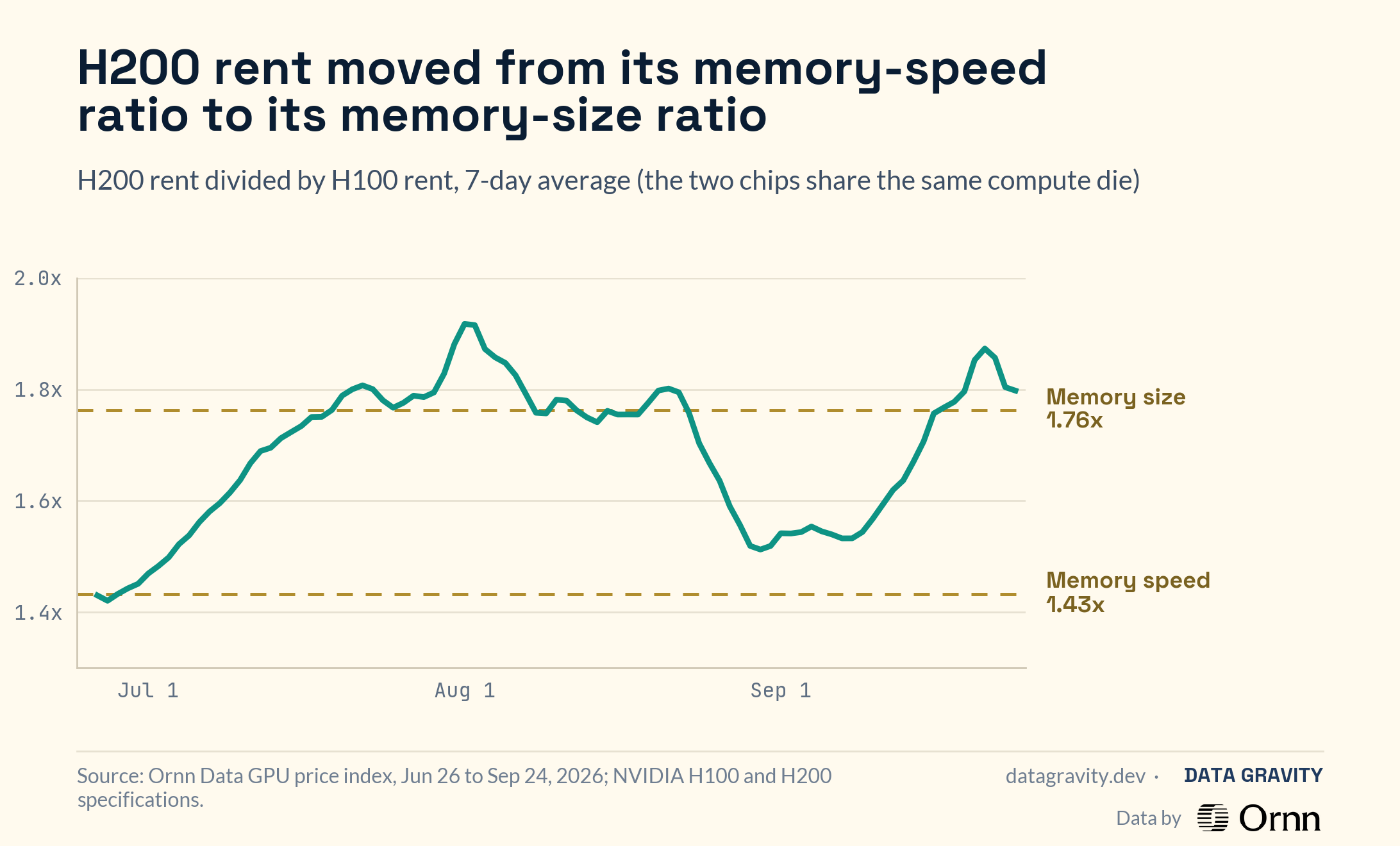
The GPU rental market has bifurcated into distinct tiers with diverging economics. A100s now rent at 80% of their one-month rates five years out, establishing them as the durable baseline for cost-sensitive open-weight inference ($0.29/M tokens vs H100 at $0.66). Meanwhile, B200s command 21% premiums expected to fade within a year as supply normalizes. Memory capacity has become the primary value driver: H200s rent at exactly 1.76x H100 rates since July—matching their memory ratio rather than compute ratio—signaling a structural shift where high-bandwidth memory specs increasingly anchor GPU pricing. This dynamic is accelerating A100 occupancy, which rose 37% in six months despite only 13% supply growth, driven by cost-sensitive workloads migrating to open models after Anthropic reduced Claude Code limits 17% and OpenAI cut GPT-6 message allowances by 50-55%, pushing users toward cheaper alternatives that run efficiently on older hardware. Micron's gross margin hit 84.9% (exceeding NVIDIA's 75%), forcing NVIDIA to guide margins down to 71-72% due to memory costs, with high-bandwidth memory contracts resetting sharply higher in 2027.
SemiAnalysis
SemiAnalysis's bottom-up facility-level tracking of 1,000+ Chinese datacenters across 60+ operators reveals 24GW of delivered capacity plus ~50GW in pipeline, contradicting widely cited estimates that differ by 15x and claims of high vacancy. China's datacenter market is now larger than EMEA and the rest of Asia combined, with growth at an inflection point: in 2Q26, combined capex of Alibaba, Tencent, and Baidu reached $20B (more than doubling YoY), and all three posted negative free cash flow for the first time—the largest capex step-up in the sector's history. ByteDance, the largest private spender, occupies roughly 20% of delivered Chinese datacenter capacity and rents nearly all of it, making it the single most important wholesale customer for all colocation players. Listed players GDS and VNET captured barely one-third of ByteDance and Alibaba orders in 2024–2026YTD, indicating massive unmeasured demand flowing to unlisted operators. Chinese hyperscalers deliver 100MW facilities in under 12 months versus 24–26 months in the US, with capex falling despite faster builds. The "Eastern Data, Western Compute" policy funnels quota approvals to western hubs where prefab construction, abundant labor, and cheap power compress timelines and costs—a structural advantage the West cannot match on speed or unit economics. State-owned carriers still own one-third of national capacity, while power grid companies' capex accelerated 24% above the 14th Five-Year Plan blueprint, with the 15th plan (2026–2030) layering another 40% on top to over $746B (¥5T).
Exponential View Newsletter via Exponential View
Meta's Muse personal AI agent became the top free iPhone app in the US with nearly 3 million downloads and ~500k active users, demonstrating consumer demand for agents that complete real tasks like flight refunds, restaurant bookings, and compensation claims. However, the launch exposed fundamental structural conflicts: Meta's business model—taking transaction fees from merchants like Expedia—creates misaligned incentives where the agent serves Meta's revenue interests rather than the user's, a problem that could undermine trust as the agent matures. Amazon explicitly blocked Muse from using Amazon.com, citing unauthorized AI agent access, because agents eliminate window-shopping behavior and convert traffic from a revenue line into a cost line. Amazon simultaneously deploys its own Buy for Me agent to shop competitors' sites, signaling that agent adoption could fundamentally restructure e-commerce economics by disintermediating search and discovery, with winners determined by who controls the agent rather than who controls the storefront.
Stripe Acquires OpenRouter for $7B, Validating Multi-Model Inference Marketplace and Routing Infrastructure as Critical
Latent.Space
Stripe's $7B acquisition of OpenRouter validates the thesis that no single AI model will dominate and that routing infrastructure is critical infrastructure. OpenRouter grew from dismissed "wrapper" status to serving 10+ trillion tokens per day across dozens of frontier models, proving the market for model-agnostic inference platforms. The deal signals Stripe's strategic pivot toward AI payments and fraud prevention as core infrastructure plays.
CNBC (Ashley Capoot) via Techmeme
A DC Circuit appeals court panel ruled 2-1 that Claude's integration with Department of Defense systems constitutes a "statutorily covered national-security risk" under 41 U.S.C. § 4713, upholding the Pentagon's March 2026 blacklist and blocking Anthropic from federal contracts. The designation prevents the U.S. military from using Anthropic's models and blocks defense contractors from using them in DOD work. The conflict originated when negotiations over Claude's deployment on the DOD's GenAI.mil platform collapsed in September 2025: the DOD wanted unfettered access across all lawful purposes, while Anthropic sought assurance that its technology would not be used for fully autonomous weapons or domestic mass surveillance. Judge Gregory Katsas wrote that Defense Secretary Pete Hegseth raised concerns about "overly constrained" AI models potentially shutting down unexpectedly and being "subject to manipulation." A separate San Francisco federal judge ruled last month that one parallel designation was illegal, but this appellate decision upholds the second designation. The ruling significantly constrains Anthropic's addressable market and creates precedent for treating AI model providers as supply-chain risks in defense procurement.