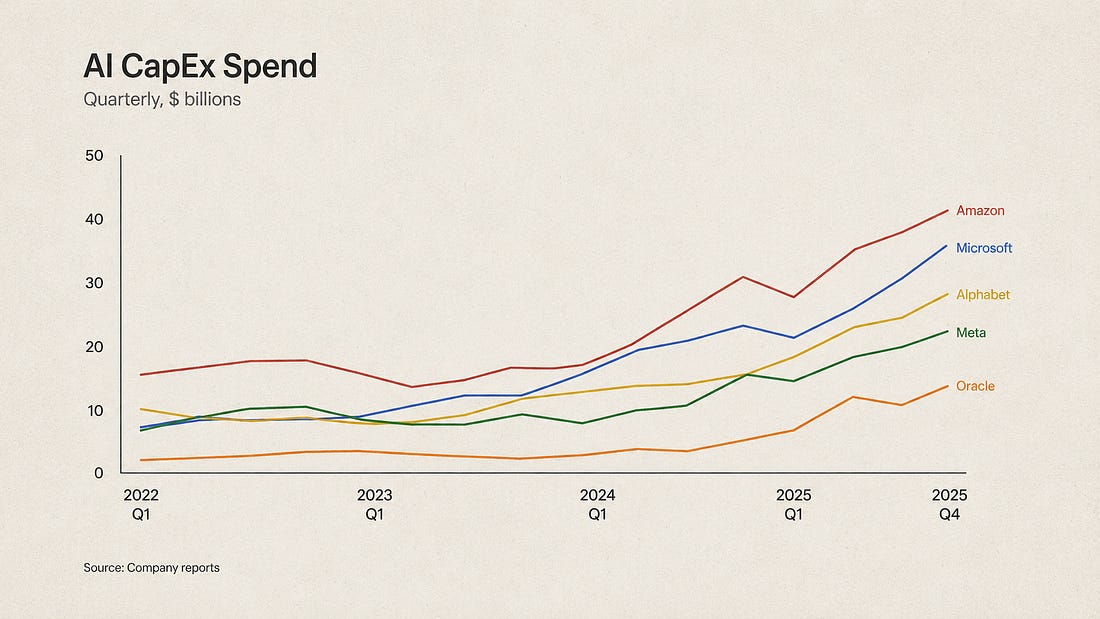
Alphabet announced an $85B capital raise with Sundar Pichai explicitly citing "compute supply" as the primary limitation on AI scaling. Google's capital expenditure will reach $180-190B in 2026—6x larger than 2022 levels and 2x last year's spending—with the overwhelming majority directed to technical infrastructure. Nearly 40% of the equity raise will cover tax obligations from employee equity awards amid AI talent competition, signaling the scale of compute buildout required to compete in frontier AI and the economic pressure on margins from infrastructure costs.
Anthropic's revenue jumps to $47B run-rate in 7 months; $65B raise funds growth into existing demand rather than speculative scaling
Limitless
Anthropic's revenue accelerated from $9B to $47B run-rate in just seven months, yet the company pursued a $65B private raise and is moving toward a public offering to fund growth into existing demand rather than to cash out before profitability materializes. This inverts the dot-com playbook where IPOs preceded revenue. The pattern holds across frontier labs: OpenAI is spending $2.25 per $1 of inference revenue, and SpaceX similarly raises capital to fund growth into proven demand.
SemiAnalysis released a comprehensive total cost of ownership framework modeling when orbital compute becomes economically viable versus terrestrial datacenters, accounting for launch costs, radiator systems, reliability constraints, and semiconductor production ceilings through 2050. The base case shows space datacenters starting at 4x+ cost premium in 2026 but reaching parity around 2040, with an "Elon Musk scenario" showing near-parity by early 2030s if terrestrial capacity becomes constrained. However, the analysis identifies a critical "fifth layer" constraint: TSMC N3 wafer capacity and HBM supply cannot keep pace with accelerator demand, making chip fabrication the universal bottleneck for both terrestrial and space deployments well into the future. This directly challenges narratives about imminent space datacenter scaling and explains why terrestrial datacenter capacity additions will outpace actual chip availability for years.
Nvidia RTX Spark brings 120B-parameter models to Windows laptops with unified memory architecture
Liberty’s Highlights
Nvidia announced a system-on-chip for Windows laptops pairing a Blackwell RTX GPU (6,144 CUDA cores) with a 20-core Grace CPU and up to 128GB unified memory, enabling local inference of frontier models with 1M token context windows. This represents a significant breach of Intel/AMD's x86 moat and shifts inference economics by enabling on-device execution, though Windows ecosystem compatibility via Prism emulation remains a question mark versus Apple's Rosetta.
Source: Liberty’s Highlights
Axiom Math achieves 99% on formal proof benchmark, vastly outpacing OpenAI o3's 4.9%
Latent.Space
Axiom's system generates both code and mathematical proofs of correctness in Lean, a formal verification language, achieving 99% on the Verina formal proof benchmark compared to OpenAI o3's 4.9%. This suggests a fundamentally different approach to AI training than statistical reward signals like RLHF. Formal verification enables higher sample efficiency in RL, better compounding of knowledge across training iterations, and trustworthy training data at scale—addressing what researchers argue is a critical bottleneck frontier labs haven't solved.
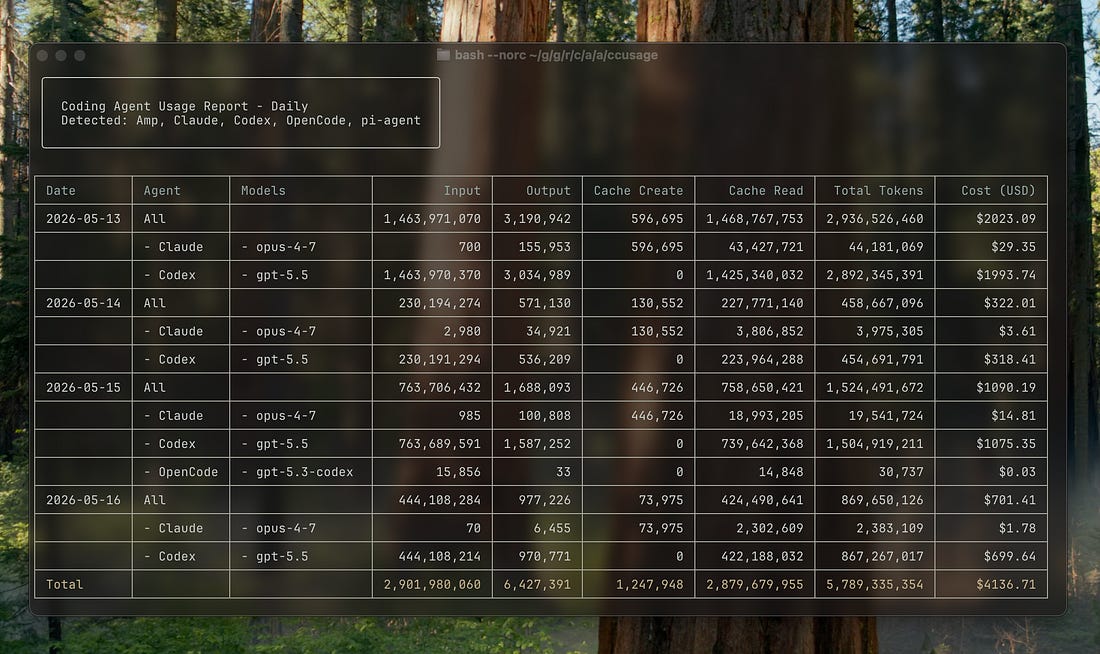
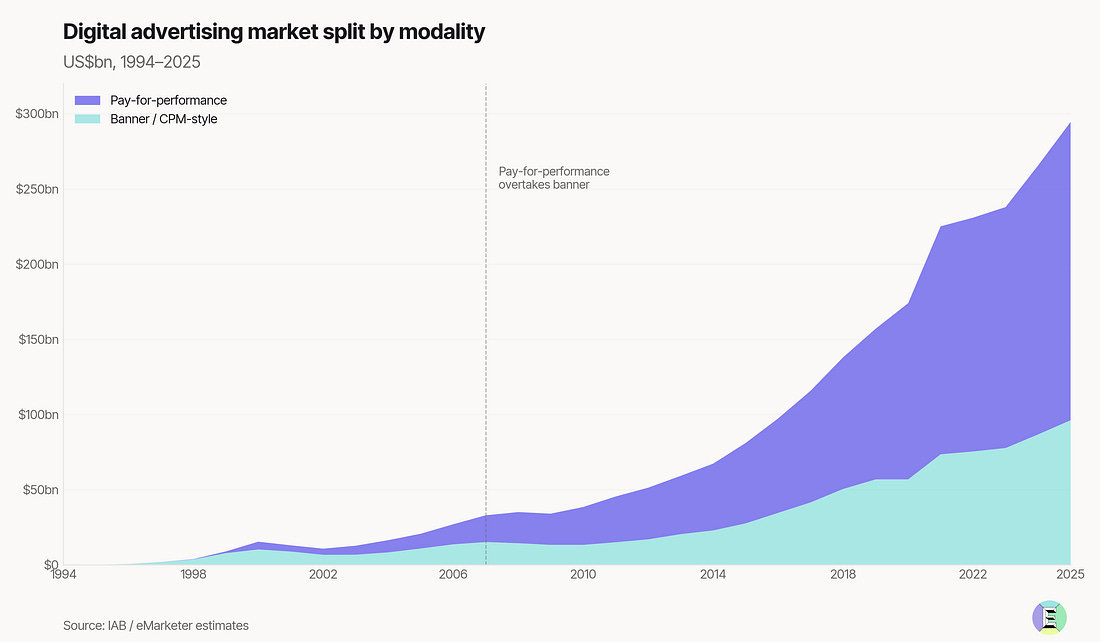
Moving from flat-rate AI subscriptions to usage-based token pricing will expand markets by enabling attribution and value measurement, just as performance advertising grew 20x larger than display advertising on a per-impression basis. Companies that can connect token spend to business outcomes will scale spending aggressively, while those that can't will freeze budgets, creating winners and losers across the stack.
Source: Azeem Azhar, Exponential View
Microsoft positions itself as "Frontier Intelligence Platform" enabling enterprises to build proprietary AI
Latent.Space
Microsoft's Build strategy centers on multi-model harnesses (OpenClaw, Scout), context layers (Work IQ), and private evals as the core IP moat for customers rather than reliance on any single frontier model. This shifts the value equation from API consumption to ecosystem lock-in through accumulated traces and company-specific evaluation data.
Dwarkesh Patel in YouTube (Dwarkesh Patel) published a video titled "Elon Musk – "In 36 months, the cheapest place to put AI will be space"". Main takeaways:
Musk claims space datacenters will be economically optimal for AI within 30-36 months due to 5x solar efficiency gains and elimination of battery costs, despite GPU servicing challenges.
Power generation is the binding constraint on AI scaling outside China; US electrical output is flat while chip demand grows exponentially, creating a fundamental mismatch.
xAI's Colossus 2 required building private power plants and interconnecting multiple gas turbines across state lines; a gigawatt facility requires ~330,000 GB300s plus 40% cooling overhead plus 20-25% servicing margin.
Utility interconnect agreements take 1+ years and utilities are structurally slow; space avoids terrestrial regulatory and infrastructure bottlenecks entirely.
SpaceX and Tesla are building toward 100 gigawatt/year solar cell production; space-based solar cells are 10x cheaper than ground-based (no glass, framing, batteries needed).
NVIDIA announced RTX Spark, a new superchip for Windows PCs designed to run personal AI agents locally with 1 petaflop of AI performance and up to 128GB unified memory. Main takeaways:
RTX Spark combines Blackwell RTX GPU (6,144 CUDA cores, FP4 precision) with 20-core NVIDIA Grace CPU via NVLink-C2C, enabling 120B-parameter LLMs with 1M token context on-device
NVIDIA and Microsoft built native Windows security primitives and NVIDIA OpenShell runtime to enable agents to run securely on primary PCs with user-defined policies
Adobe rearchitecting Photoshop and Premiere from ground up for RTX Spark, delivering 2x faster AI and graphics performance; Premiere gets new GPU-accelerated video pipeline leveraging unified memory
RTX Spark laptops (14-16 inch, as thin as 14mm, 3 lbs) and compact desktops launching fall 2026 from ASUS, Dell, HP, Lenovo, Microsoft Surface, MSI; Acer and GIGABYTE to follow
Over 100 software providers (Adobe, Blackmagic, Blender, ComfyUI, OTOY) and game studios (KRAFTON, NetEase, Remedy, Riot, XBOX) adopting RTX Spark platform
Latent Space published a comprehensive technical recap of Microsoft Build announcements, detailing seven new MAI models and the 109-page MAI-Thinking-1 technical report. Main takeaways:
MAI-Thinking-1 is a 35B active parameter MoE with 256K context, trained on 30T tokens using 8192 GB200 GPUs, achieving 97% on AIME 2025 and 53% on SWE-Bench Pro with no third-party distillation or synthetic data
MAI-Code-1-Flash achieves 51% on SWE-Bench Pro with only 5B active parameters, positioned as Haiku-class alternative for VS Code and GitHub Copilot
Microsoft disclosed exact MFU metrics, scaling ladder methodology, data curation pipelines, and infrastructure utilization—unusually transparent for frontier-scale model reporting
MAI-Image-2.5 ranked #2 on Image Edit Arena (score 1401); MAI-Transcribe-1.5 achieves 276x realtime speed at 2.4% AA-WER across 43 languages
Microsoft positioned MAI as tier-2 neolab with domain-specific finetuning incentives, contrasting with frontier labs that have largely eliminated finetuning; emphasized MAIA 200 custom silicon delivering 30% better performance-per-dollar and 1.4x performance-per-watt versus GB200
Limitless Podcast published a video essay on the synchronized mega-IPOs of SpaceX, OpenAI, and Anthropic and their implications for AI capital markets. Main takeaways:
Combined IPO raises of $180B across three companies exceed entire dot-com bubble ($164B) in three IPOs vs. three years; signals AI CapEx costs have exceeded private capital capacity
Index providers waived profitability requirements and cut seasoning window from 90 days to 5 days for SpaceX IPO, forcing $30T+ in passive 401k/retirement funds to absorb ~24% of IPO supply at IPO valuation—reversing post-2000 dot-com protections
Anthropic achieved $45B ARR (up from $9B end-2025), hitting $20B target in 1.5 months; demonstrates proven revenue model unlike SpaceX's unproven space data center thesis
All three companies targeting Q4 2026 IPO window; timing suggests coordinated capital raise to fund ongoing AI infrastructure buildout rather than individual company milestones
Structural shift: passive index inclusion rules being rewritten in real-time to accommodate mega-IPO demand, creating systemic risk similar to pre-2000 bubble dynamics
Latent Space published a long-form interview with Applied Intuition founders Qasar Younis and Peter Ludwig on physical AI deployment, autonomy infrastructure, and the evolution from simulation tooling to a $15B platform company. Main takeaways:
Applied Intuition operates L4 driverless trucks in Japan today and serves 18 of top 20 global non-Chinese automakers plus defense, agriculture, and construction sectors with 30+ products across simulation, OS, and autonomy models
Physical AI differs fundamentally from screen-based AI: safety-critical machines require statistical validation ("how many nines" of reliability, mean time between failures) rather than binary pass/fail, shifting from deterministic tests to probabilistic safety guarantees
Real bottleneck is not model intelligence but deployment onto constrained hardware: onboard vehicle models need millisecond latency, low power, small size via distillation, while data-center models can be large and slow
Vehicles today are like "phones before Android/iOS"—fragmented across many operating systems; Applied Intuition positions itself as a consolidating platform layer with real-time control, sensor streaming, fail-safes, and reliable updates
Simulation-to-reality gap remains unsolved: no simulator perfectly represents real world (e.g., hydroplaning, construction dynamics); real-world testing will never disappear despite advances in neural simulation and RL infrastructure
Stratechery published an essay analyzing Alphabet's $80B equity raise and Berkshire Hathaway's $10B investment as a strategic inflection point. Main takeaways:
Google Services generated $89.6B revenue with $40.6B profit (45% margins) in Q1 2026, while Google Cloud generated $20B revenue with $6.6B profit (33% margins), with Cloud growing faster and margins expanding rapidly
Alphabet is issuing equity rather than debt despite $126B cash and $81B debt capacity, suggesting either massive future debt issuance or uncertainty about AI capex ROI
Berkshire Hathaway's investment mirrors its See's Candies-to-BNSF strategy: using high-margin Services cash flow to fund lower-margin but higher-absolute-dollar Cloud growth, betting compute becomes a commodity where Google's TPU cost advantage dominates
Microsoft AI published a technical report on MAI-Thinking-1, a 35B-active/1T-total sparse MoE model trained from scratch on 30T tokens without distillation. Main takeaways:
Achieves 52.8% on SWE-Bench Pro, 97.0% on AIME 2025, 87.7% on LiveCodeBench v6—competitive with Sonnet 4.6 across broad benchmarks despite smaller active parameter count
Trained on 8K GB200 GPUs using in-house distributed infrastructure (YOLO); pre-training emphasizes clean enterprise-grade data with no synthetic/AI-generated content, decontaminated against common ML datasets
RL framework sustains log-linear performance improvement over thousands of steps via robust recipe, self-distillation, and infrastructure improvements; trains three domain-specific specialists (STEM, agentic coding, helpfulness/safety) then consolidates into single model
Architecture interleaves high-sparsity MoE (8 of 512 experts per token) with dense FFNs, periodic local/global attention, and 256K context length; co-optimized with GPU infrastructure for efficient scaling
Treats model development as empirical optimization loop ('hill-climbing machine') integrating data pipelines, training infrastructure, RL environments, evaluation suites, and safety red-teaming