Salesforce's agentic AI doubled developer output and cut incidents 5%
June 3rd 2026
Today's News
Anthropic hits $47bn annualized revenue run-rate with $965bn valuation, driven by agentic coding willingness-to-pay
Benedict Evans
Anthropic's annualized revenue has surged to $47bn, up from $30bn in April, with the company now valued at $965bn—exceeding the total market cap of all US venture-backed IPOs from 1995-2000 combined. Agentic coding has driven massive willingness to pay (hundreds of thousands per programmer), with inference showing positive gross margins, though pricing and margin structure remain unsettled.
Dell AI server revenue surges to $16.1bn quarterly; Snowflake jumps 36% on AI migration thesis
Benedict Evans
Dell's AI server revenue reached $16.1bn in the latest quarter, up from $1.9bn year-ago, with $60bn full-year guidance. Snowflake stock jumped 36% on the thesis that companies migrating to AI will adopt its platform. These represent concrete flow-through signals of hyperscaler capex translating into enterprise infrastructure spending.
ByteDance considers $70bn capex increase and Qualcomm chip deal as Chinese tech giants enter AI race
Benedict Evans
ByteDance is considering a $70bn capex increase from its current $25bn and pursuing a Qualcomm chip deal, signaling that Chinese tech giants are entering the AI infrastructure race. This move carries potential sanctions implications and marks a shift in global compute competition beyond US-dominated players.
GitHub's agentic code growth strains infrastructure to 89.91% uptime; Daigle reveals micro-skills architecture for enterprise AI
Latent.Space
GitHub is experiencing explosive growth in AI-generated commits (135k+ daily, 42,896x growth in 13 months) and 14x overall commit growth, pushing the platform designed for human-speed development to its limits with availability incidents at 89.91% uptime. This signals a fundamental infrastructure challenge as coding agents become mainstream. In response, Kyle Daigle revealed GitHub's micro-skills architecture for enterprise AI workflows—distributing atomic, single-purpose skills via CLI and desktop app that integrate with existing company context (Slack, Teams, email, GitHub, Obsidian) to enable retrospective analysis and decision-making. This approach prioritizes adoption by avoiding tool retraining and reflects a broader shift from mega-skills to composable, context-aware AI primitives.
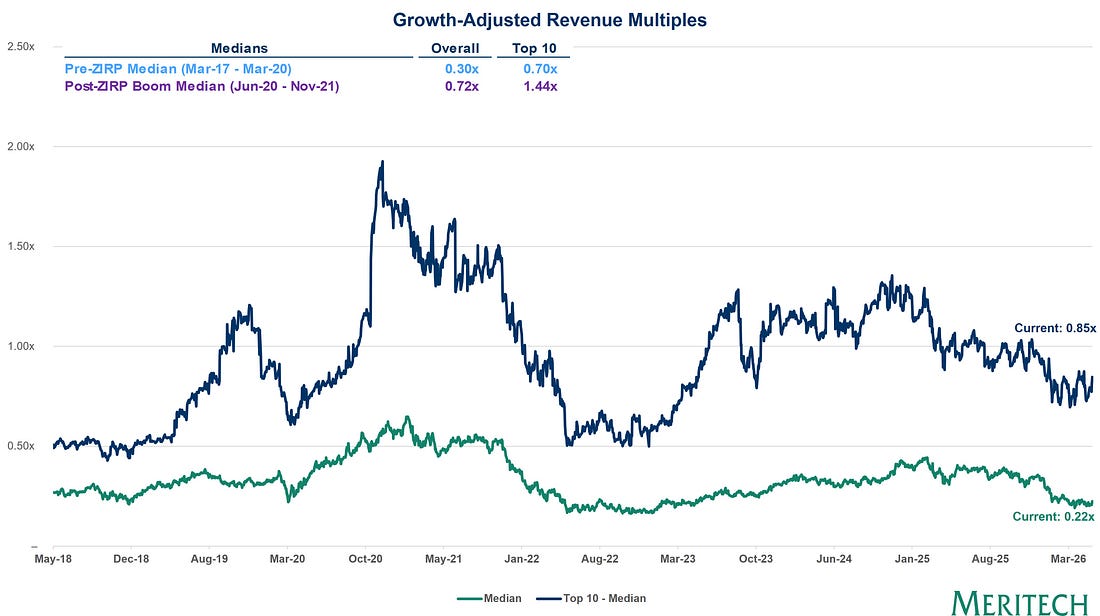
Software market bifurcates sharply on AI adoption, with top 10 trading at 18.9x ARR vs. median 3.6x
Meritech Capital
The software market is experiencing a sharp valuation bifurcation based on AI adoption. Top 10 performers trade at 18.9x ARR versus a median of 3.6x, with growth-adjusted multiples showing top performers at 0.85x (21% above pre-ZIRP) while the broader market sits at 0.22x—the widest valuation gap since 2021. This signals the market is pricing in AI-driven acceleration for leaders while punishing horizontal SaaS vendors lacking clear AI monetization paths.
In a CNBC exclusive interview at OpenAI's Stargate data center site in Saline, Michigan, CEO Sam Altman identified coding models as the single biggest driver of AI demand, noting they "got really good late last year, early this year, and then another step forward in recent months." Altman expressed confidence that the $45-50bn Stargate project (with $16bn for site development and another $30bn for infrastructure) will generate necessary returns, citing strong demand signals where companies are committing to long-term compute partnerships. He emphasized that token prices continue to decline but demand is rising faster, and predicted a shift from on-demand AI requests to always-on AI agents running in the background with full context awareness—a scenario he believes will drive far greater infrastructure consumption than currently anticipated.
Microsoft launches MAI-Thinking-1 reasoning model and publishes 109-page technical report; positions full AI stack integration from models to OS
AINews
Microsoft announced seven new MAI models at Build, with the flagship MAI-Thinking-1 reasoning model trained on 30T tokens using 8,192 GB200 GPUs, achieving 97% on AIME 2025 and 53% on SWE-Bench Pro. The model reportedly achieved 30% better performance-per-dollar and 1.4x performance-per-watt gains versus GB200 when running on custom MAIA 200 silicon. Microsoft published an unusually detailed 109-page technical report disclosing training methodology, data curation, and infrastructure metrics—including pipeline details, scaling ladders, and MFU numbers—with a deliberate choice to use zero synthetic data and zero third-party distillation throughout pretraining and post-training. This level of disclosure is uncommon at frontier-model scale and positions Microsoft as a serious first-party model developer. Build messaging emphasized local AI execution on Windows, agent-native development surfaces in GitHub Copilot, Web IQ grounding APIs, and hardware concepts like Project Solara and Scout, suggesting Microsoft is attempting to integrate custom models, silicon, cloud infrastructure, developer tools, and device platforms into a coordinated agent platform.
Salesforce published a detailed case study on agentic AI transformation in engineering. Main takeaways:
Work items completed per developer up 50.8% YoY; PRs merged per developer up 79%; Effective Output score up 151.3% YoY after standardizing on Claude Code and removing token limits
Product team completed 33-endpoint API migration in 13 days (18x faster than traditional approach) using rule-based Claude framework with autonomous PR loops and parallelized execution
Quality improved simultaneously with speed: total incidents dropped 5% despite increased PR volume, suggesting agentic workflows with embedded guardrails improve rather than trade off quality
Engineers now building reusable Claude Code skills as engineering artifacts; role evolution underway with designers and product managers coding directly; junior engineer growth and team structure still being actively experimented with
Not Boring published a 40,000-word essay on the Electric Stack—the four core technologies (lithium-ion batteries, magnets/motors, power electronics, embedded compute) that enable electrification across industries. Main takeaways:
Electric Stack components have declined 99% in cost since 1990 (12.6% annually): batteries 98.7%, motors 98.8%, power electronics 99.5%, compute 99.9%
China now controls 75% of global lithium-ion battery production and 90% of neodymium magnets; Western companies sold critical assets (GM's Magnequench to China for $70M, A123 Systems for $257M)
China is deliberately commoditizing AI while controlling energy and action; the essay argues this is the correct strategic bet given that intelligence requires physical manufacturing capability to matter
The framework challenges the implicit American assumption that winning AI models equals winning the future, arguing instead that control of the Electric Stack (and thus EVs, drones, robots) is the more defensible position
Mastery of the stack compounds across domains: BYD's expertise in batteries transfers to EVs, energy storage, and drones, creating a superior 'LEGO set' relative to Western fragmentation
CNBC published an exclusive interview with OpenAI CEO Sam Altman at the Stargate data center site in Michigan. Main takeaways:
Coding models are the single biggest driver of current AI demand; they transformed company productivity and efficiency starting late 2025/early 2026, with another step forward in recent months.
OpenAI remains confident $45-50B Stargate investment will generate necessary returns because token price declines are outpaced by rising demand; future AI will run continuously in background with full user context, driving far higher infrastructure consumption than currently anticipated.
Companies adopting AI most aggressively are hiring most; companies citing AI-driven layoffs are actually adopting AI least, contradicting narrative that AI primarily displaces workers.
Models remain "quite dumb" and jagged—excel at small tasks but struggle with long-term complex supervision; this creates extended runway for human workers to remain economically valuable alongside AI tools.
Altman revised prior pessimism on job displacement after observing that people prefer human interaction, collaboration, and human-created content; underestimated how long humans stay central to economy.
Latent Space published a long-form interview with GitHub COO Kyle Daigle on AI's impact on developer infrastructure and workflows. Main takeaways:
GitHub experienced 1400% growth in agent-generated code commits in 2026, straining infrastructure originally designed for human-speed development and causing public uptime incidents.
Kyle Daigle uses AI agents to recursively analyze past context (PRs, Slack, Teams transcripts, Obsidian notes) to inform forward-looking strategy, rather than simple prompt-response interactions, demonstrating a leadership workflow pattern.
GitHub is shifting from code completion to multi-modal agent orchestration across CLI, desktop app, cloud agents, and MCP servers, with Actions evolving into a general-purpose compute layer for CI/CD and automation.
Pull requests, dependency management, and open-source contribution models face structural challenges as AI agents flood repositories with code, requiring new trust and validation mechanisms (prompt requests, AI review, vouching systems).
GitHub Copilot is evolving toward ambient, background agent execution integrated into company context systems, with new products like WorkIQ and FoundryIQ announced at Microsoft Build.