Anthropic closed a Series H funding round led by Altimeter, Dragoneer, Greenoaks, and Sequoia that values the company at $965 billion—higher than OpenAI's $852 billion valuation—while disclosing annualized revenue run rate of $47 billion, up from $9 billion in December. This represents a 5x revenue acceleration in five months and signals that enterprise Claude adoption has reached hyperscaler scale, validating Anthropic's infrastructure expansion strategy despite a smaller compute footprint than competitors.
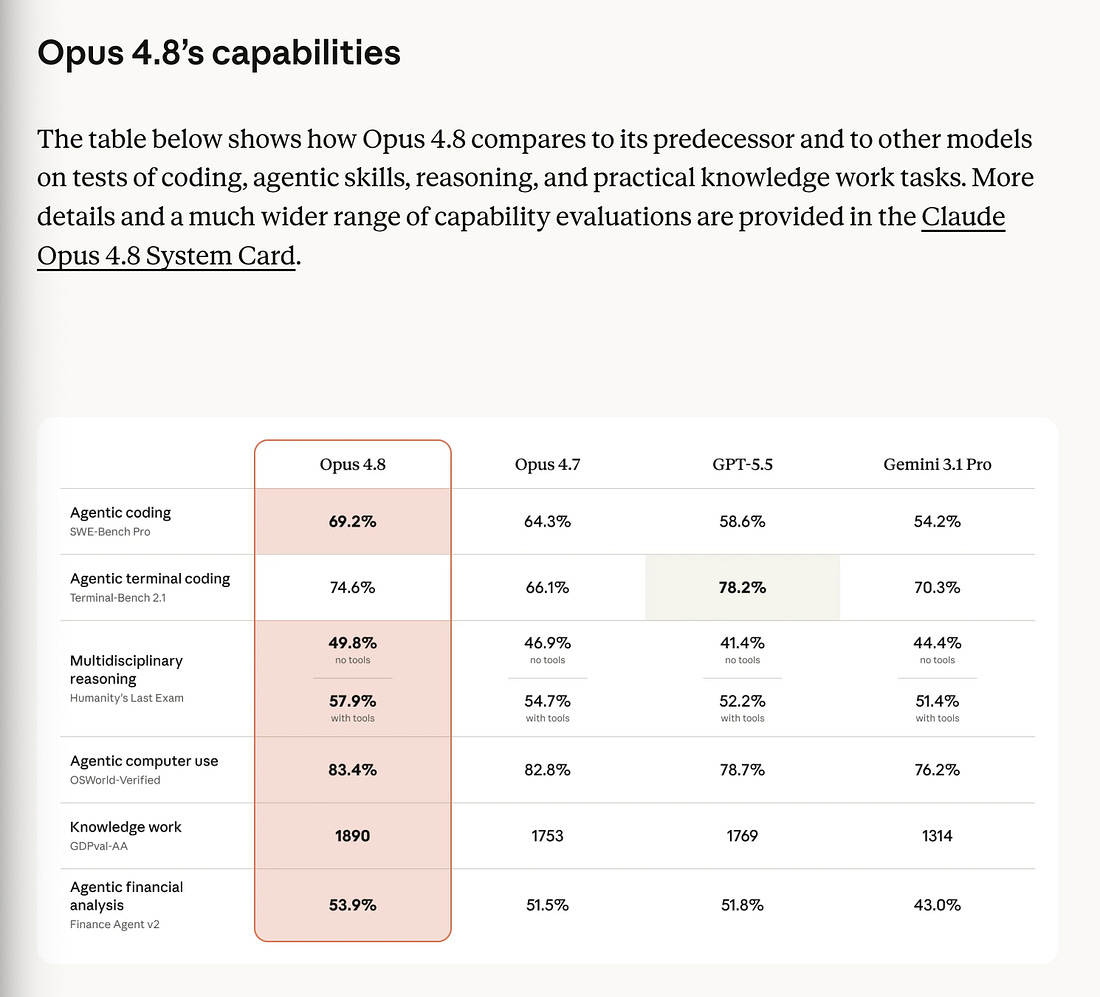
Anthropic released Claude Opus 4.8, achieving 69.2% on SWE-Bench Pro (+10 points vs GPT-5.5) and 1890 Elo on GDPval-AA (+137 vs 4.7), with notable improvements in honesty, self-awareness, and long-horizon coding tasks while maintaining Opus 4.7 pricing. The model introduces dynamic workflows allowing Claude Code to tackle codebase-scale migrations across hundreds of thousands of lines of code, and effort controls letting users trade speed for quality. Early testers report Opus 4.8 is four times less likely than its predecessor to allow flaws in code to pass unremarked, and it's the only model to complete every case end-to-end on Anthropic's Super-Agent benchmark at cost parity with GPT-5.5.
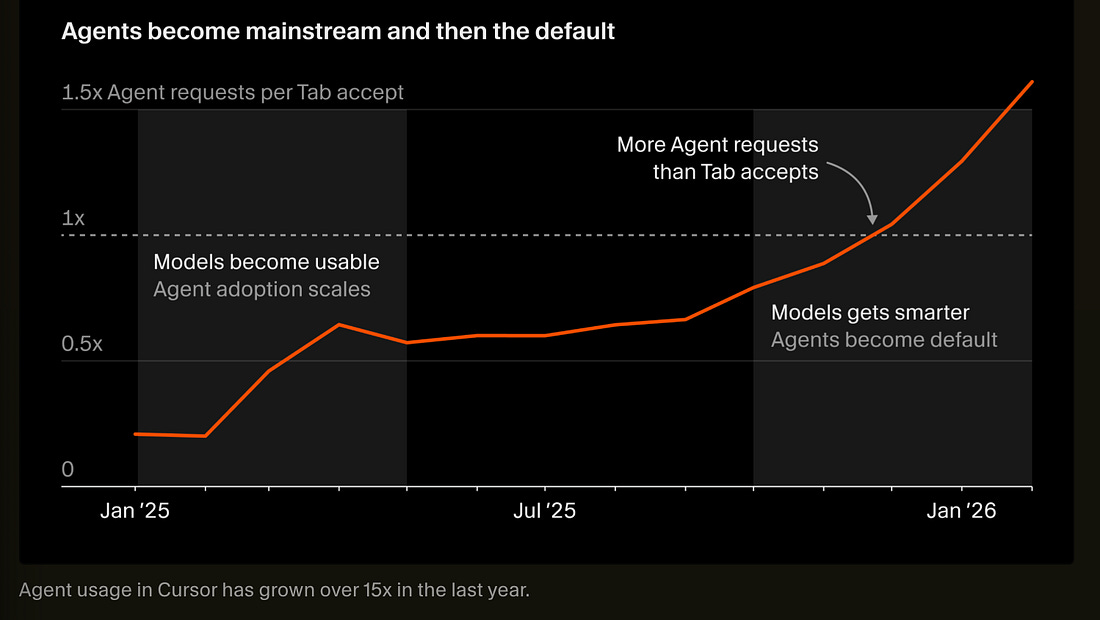
Cognition closed a Series D led by Lux Capital and General Catalyst at a $26 billion valuation, disclosing $492 million annualized revenue run rate and >10x enterprise usage growth since the start of 2025. Devin's share of merged pull requests jumped from 16% to 80% in just two months with 7x overall PR growth, signaling that the December 2025 model inflection (Opus 4.5, GPT 5.2) made spec-to-PR workflows practical enough for widespread autonomous adoption.
SpaceX filed its S-1 revealing three distinct business units—Space, Starlink connectivity, and AI infrastructure—with AI set to become the largest revenue segment within a year. The company reported $18.7 billion in FY25 revenue (up 33% YoY) and is targeting a $1.75 trillion valuation that would make it a top-10 global company. The AI business, driven by xAI's Colossus data centers and a reported $15 billion annual contract with Anthropic for ~500MW of capacity, signals major infrastructure buildout implications for AI compute and connectivity.
SK Hynix and Micron both reached $1 trillion market capitalizations in the same week, with SK Hynix up 1,000% YTD and Micron up 19% after crossing $700 billion, signaling that high-bandwidth memory—not logic—is now the scarcest input in AI infrastructure. UBS tripled its Micron price target from $535 to $1,625 per share, citing long-term agreement opportunities with partially fixed pricing and structural changes AI has driven to the memory complex. The consumer signal is stark: Valve raised the Steam Deck OLED from $549 to $789, marking the first time AI-driven component shortages visibly hit consumer pricing.
Dell's AI infrastructure business, which didn't exist as a segment until late 2023, has grown to exceed its foundational Client Solutions Group (PC division) in size, signaling that AI infrastructure buildout is now the dominant driver of hardware economics. Industry-wide optical component shortages are driving price increases across lasers, fibers, and connectors, creating supply chain constraints at multiple layers of the stack.
Jamin Ball argues that if GPUs retain meaningful value beyond their initial offtake contracts, neoclouds can recontracts sites at lower per-hour rates with debt fully paid off, potentially unlocking outsized margins on inference workloads. Ball projects ~150GW of new AI data center capacity buildout over the next 4.5 years (~$7.5 trillion total spend, or ~5% of annual US GDP), with potential enterprise value creation of $13.5 trillion if $90 billion of enterprise value is created per deployed GW. Even assuming only 20% is captured by neoclouds, that represents over $2.5 trillion of enterprise value creation, suggesting a boom in independent cloud providers similar to the independent power provider market.
I read the full essay. Main takeaways:
- Context Engineering (not prompt engineering) is the #1 job for production agent builders: agents must share full traces and context, not isolated messages, to avoid compounding errors from miscommunication across subtasks.
- Multi-agent parallelism is currently fragile because decision-making becomes too dispersed; single-threaded agents with optional compression layers for long contexts are more reliable than parallel subagents that make conflicting implicit decisions.
- Cognition's production approach: Claude Code uses minimal subagents only for well-defined questions (not parallel code work) to preserve main agent context; edit-apply models have consolidated back to single-model decision-making as model capabilities improved.
- The field lacks dedicated infrastructure for cross-agent context-passing; reliable agent collaboration will emerge as a byproduct of better single-threaded human-agent communication, not as a separate architectural problem.
I read the full essay. Main takeaways:
- Both Anthropic and OpenAI shifted enterprise pricing in April 2026 to API-based models (matching public API rates) instead of discounted per-seat plans, locking in higher costs for year-long contracts
- Coding agents (Claude Code, Codex) are driving massive token consumption: power users spending $1,000+/month per vendor vs. $200/month subscription, fundamentally changing unit economics
- Anthropic's $1.25B/month SpaceX Colossus deal implies inference budgets have scaled dramatically; Q2 2026 revenue rumored at $10.9B with potential first profitable quarter
- Enterprise hiring surge (OpenAI 32.6% of 703 open roles in enterprise sales; Anthropic 26.9% of 390) signals aggressive go-to-market push for agent products
- April 2026 marks inflection point where revenue implications of November 2025 agent capability improvements are landing materially for labs and impacting customer budgets
I read the full funding announcement and product releases. Main takeaways:
- Anthropic raised $65B Series H at $965B valuation; run-rate revenue crossed $47B earlier this month, up from $40B+ disclosed in May
- Secured 15GW of new compute capacity: 5GW from Amazon, 5GW Google/Broadcom TPU, plus SpaceX Colossus GPU access; AWS remains primary training partner
- Claude Opus 4.8 released with improved coding, agentic reasoning, and 4x reduction in code-flaw pass-through vs 4.7; fast mode now 3x cheaper
- Dynamic Workflows feature enables Claude Code to run hundreds of parallel subagents for codebase-scale migrations (hundreds of thousands of lines)
- Mythos-class models (higher capability than Opus) in limited cybersecurity deployment; general release expected within weeks pending cyber safeguards
I read the full essay. Main takeaways:
- Data centers are functioning as commercial "Buyers of Capabilities" (analogous to DoD/NASA procurement), willing to pay premium prices for unproven hard tech to solve supply constraints, accelerating cost curves for nuclear, geothermal, HVDC grids, solid-state transformers, and other infrastructure technologies years ahead of normal timelines.
- The essay draws explicit parallel to Apollo Program: technologies that seemed wasteful at the time (58% public opposition in 1961) ultimately generated spillover innovations (fireproof fabrics, CAT/MRI imaging, cordless tools, water filtration, cleanroom protocols) that transformed civilian life, and data center capex may play similar role for reindustrialization.
- Data center demand is creating "dilution-free capital" and "negative working capital cycle" funding for hard tech startups that would otherwise die in the Valley of Death, making viable companies that might have failed under normal commercial timescales.
I read the full essay. Main takeaways:
- Projects 150GW of new AI datacenter capacity by 2030 (~$7.5T total spend, ~5% of annual US GDP), implying $13.5T enterprise value creation if $90B/GW valuation holds, with neoclouds capturing meaningful share
- SpaceX/xAI's Colossus capacity generating ~$15B/year revenue from Anthropic alone (~$30M/MW), created in 23 years less than SpaceX's baseline business revenue
- Coreweave guidance: $18.5B annualized run rate by end-2026 on 1.7GW deployed capacity (~$11M/MW), trades 6x NTM revenue vs Nebius/IREN at 10x
- Neocloud business model economics remain unproven despite massive revenue potential; independent power provider (IPP) market precedent suggests long-tail fragmentation likely
- Anthropic compute-constrained enough to accept 90-day cancellation clause at premium pricing, signaling acute capacity scarcity and willingness to overpay