Nvidia reported extraordinary Q1 results with data center revenue of $75.2B (85% YoY growth) and net income of $58.3B (211% YoY), with demand Jensen Huang described as "parabolic." Hyperscale revenue grew 115% YoY to $38B while ACIE (AI Clouds, Industrial, Enterprise) grew 74% YoY to $37B; networking revenue hit a record $14.8B (+199% YoY). For context, Google's last comparable growth rate was Q4 2005 when its market cap was $120B—Nvidia achieved this at $5.2T with 75% gross margins while shipping physical products.
The company announced Vera, a custom ARM-based CPU codesigned with Rubin GPUs for agentic AI and reinforcement learning workloads. Management claims visibility to nearly $20B in CPU revenue this year and positions Vera as opening a $200B TAM, positioning Nvidia to become the world's leading CPU supplier. Nvidia also announced a "deepened" partnership with Anthropic, though specifics remain unclear. On the infrastructure side, Nvidia highlighted that partner data centers exceeding 10 megawatts have nearly doubled in one year to surpass 80 sites, and emphasized that software optimizations have driven a 2.7x increase in throughput and 60% reduction in cost per token on GB300 compared to six months prior.
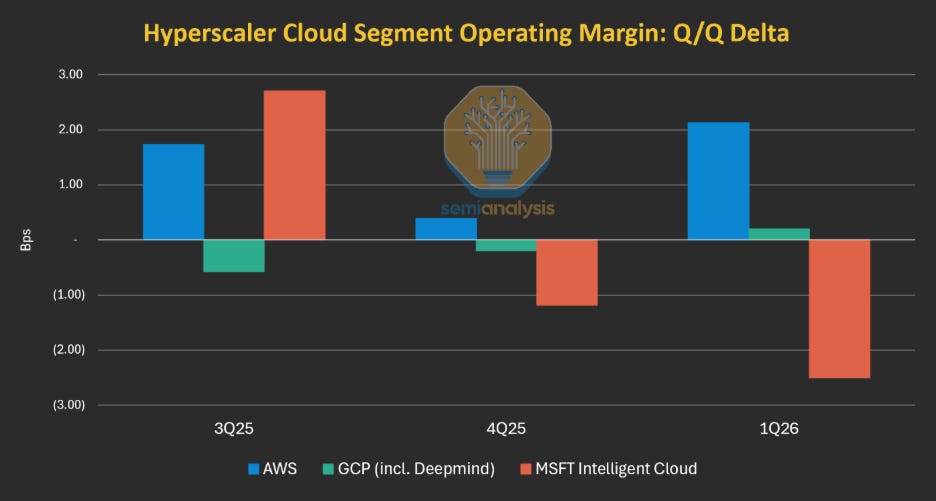
SemiAnalysis estimates AWS Bedrock reached $5.5B annualized run-rate in Q1 2026, representing 37% of AWS AI revenue (up from 9% a year prior) and growing 170% quarter-over-quarter. The revenue-share model on Anthropic tokens generates approximately 55% EBIT margins versus standard GPU rental margins of ~20-30%, explaining AWS's margin inflection while Azure and GCP remain 80%+ IaaS-focused. This structural shift in cloud AI economics—where managed model endpoints generate higher margins than raw compute—is reshaping competitive dynamics across hyperscalers.
Goldman Sachs estimates $7.6 trillion in AI-related capital spending between 2026-2031 across compute, data centers, and power infrastructure—equivalent to 2.4-3.1% of annual GDP, rivaling Apollo and Manhattan Project spending relative to the economy. Packy McCormick argues that AI data center operators, facing supply constraints and bottomless budgets, are now functioning like the DoD or NASA—willing to pay premium prices for unproven technologies that can scale quickly. This is accelerating companies through the "Valley of Death" that might otherwise have failed, similar to how Apollo and Minuteman programs pulled forward integrated circuits, composite materials, and medical devices decades ahead of commercial viability. The scale of concentrated demand is creating conditions for cost-curve acceleration across multiple hard tech verticals—a potential inflection point for American reindustrialization that transcends whether the AI bubble itself sustains.
Cognition raised $1B in Series D funding at a $26B valuation, becoming the largest independent agent lab with disclosed ARR of approximately $492M and projecting >$1B by end of 2026. This represents a 2.5x valuation increase in eight months. CEO Scott Bostick disclosed >10x enterprise usage growth year-to-date and noted that more than 90% of code written internally at Cognition is written by Devin itself. The company is working with all top five U.S. health insurers, major banks, Treasury, and NASA. Cognition positions itself as "Switzerland" in the AI space—remaining neutral and model-agnostic while working with OpenAI, Anthropic, Google, and xAI—which Bostick argues is critical for customer alignment and avoiding lock-in.
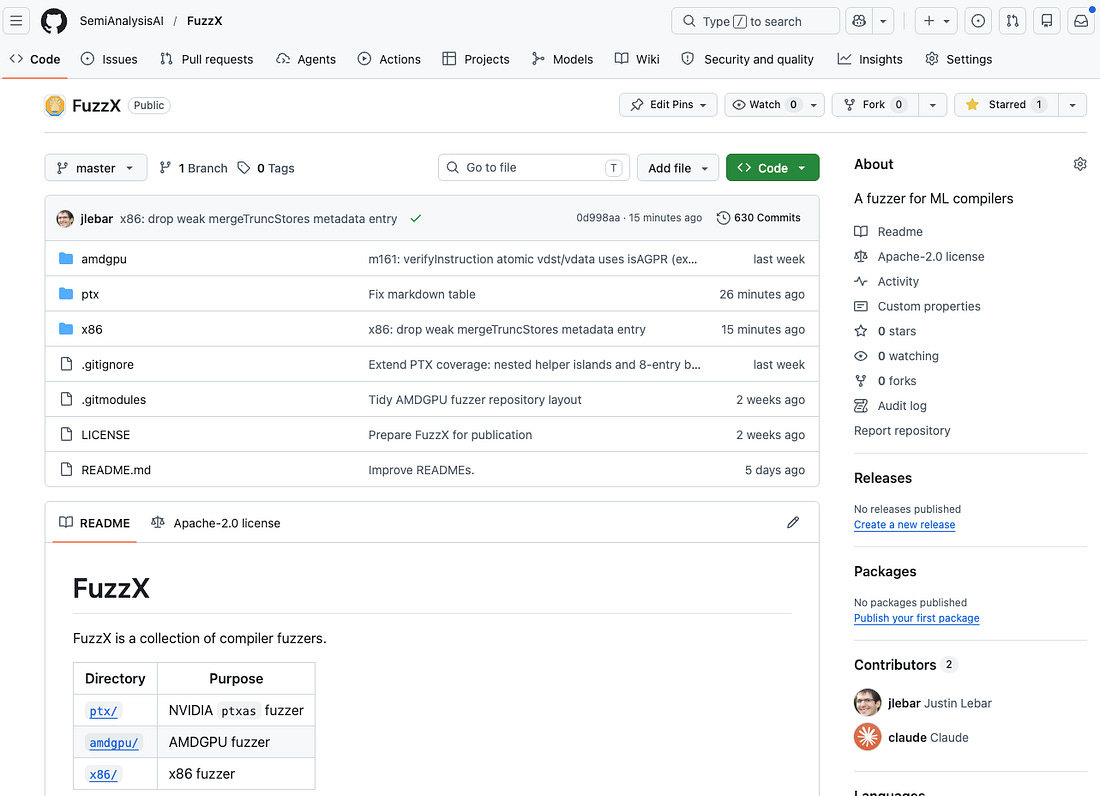
Justin Lebar, a compiler expert now at SemiAnalysis, deployed Claude Opus 4.7 to systematically search for bugs in LLVM's x86 and AMDGPU backends and NVIDIA's ptxas compiler, discovering miscompiles at rates of one to two per minute. The effort uncovered a critical atomic store bug that would cause silent data corruption—a concurrency issue that traditional fuzzing struggles to find. This demonstrates that code inspection via AI agents can discover entire classes of bugs that automated testing misses, making the token spend economically justified despite high cost. The work validates that frontier models with extended context windows can perform deep technical analysis on complex codebases, with implications for infrastructure reliability and the ROI of AI-assisted code review.
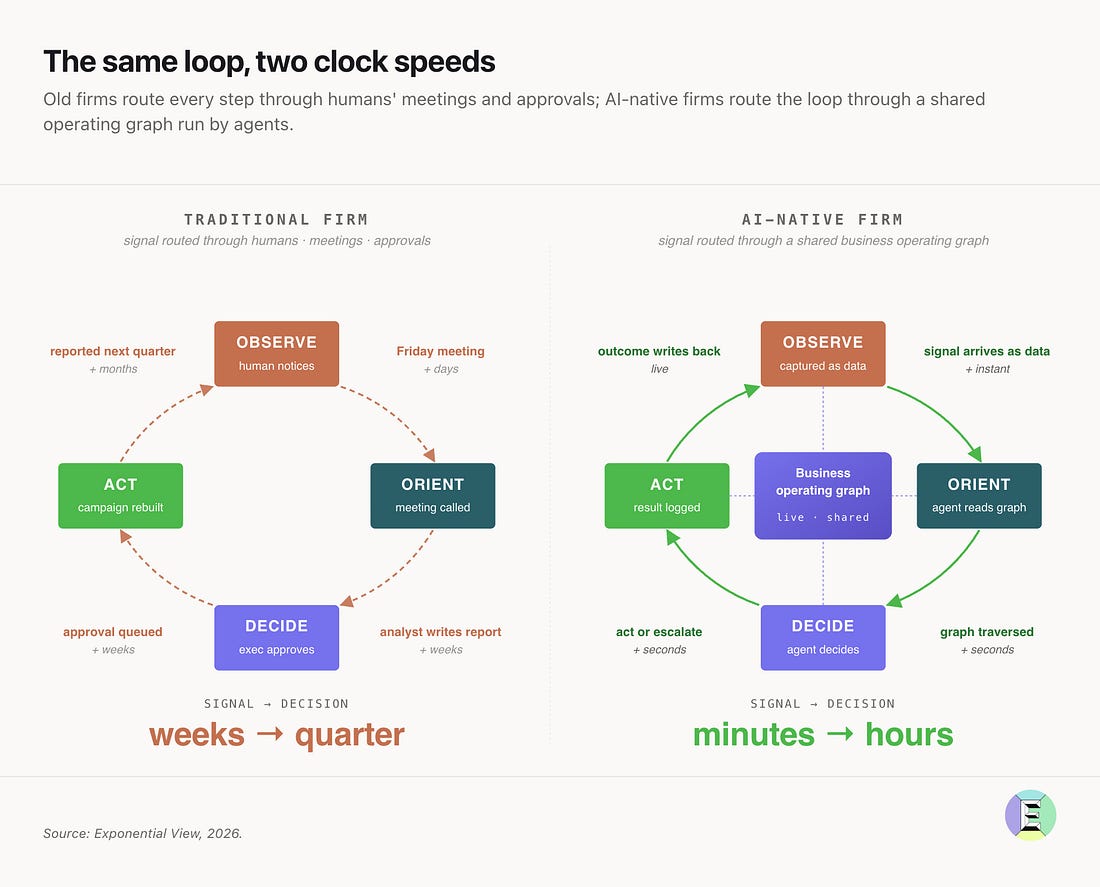
Azeem Azhar and Nathan Warren present a three-stage adoption model (lightbulb → group drive → unit drive) borrowed from electrification history, showing that 73% of executives say AI hasn't met ROI expectations because firms experience "congestion"—individual and team outputs pile up waiting for traditional approval processes. This explains why a tech executive with 1,000 engineers using Claude Code sees individual productivity up but organizational output only marginally improved. The gap between individual worker gains and firm-level returns suggests that the bottleneck is no longer compute or model capability, but organizational structure and decision velocity.
I read the full interview-based essay. Main takeaways:
- Claude Code generates $500M+ annual run-rate revenue with 10x usage growth since May release; 80%+ of Anthropic engineers use it daily
- 90% of Claude Code's codebase is self-written; tech stack (TypeScript, React, Ink, Bun) chosen as 'on distribution' for Claude's capabilities
- Anthropic saw 67% increase in PR throughput as team doubled in size, attributed directly to Claude Code adoption enabling faster iteration
- Product emerged from 'product overhang'—Claude could traverse filesystems and codebases, but no product existed to capture this capability until Claude Code
- Team operates with minimal business logic; model does almost all work via exposed tools and UI hooks, keeping client-side code lightweight
I read the full interview transcript. Main takeaways:
- CZI acquired EvoScale (ESM-3 team) and is building a 10,000 GPU cluster dedicated to biological research, positioning Biohub as a frontier AI lab for biology with $1B/year budget
- Biohub's roadmap progresses from Virtual Cell (modeling how billions of human cells interact) to Virtual Immune System, with new models released: VariantFormer (genetic variation to tissue-specific gene activity), CryoLens (cryoET structural analysis), and scLDM (single-cell data generation)
- Chan articulates specific clinical applications: cellular engineering to reprogram T-cells for disease detection/treatment, and understanding autoimmune balance to address MS, lupus, and potentially dementia
- CZI explicitly positions itself as basic research complement to Gates Foundation's translational focus, with physical colocation of AI researchers, engineers, and cell biologists across Chicago, NYC, and SF as core strategy
- The framing mirrors frontier AI lab structure: compute-intensive modeling replacing in vivo experiments (1000x cheaper/faster), similar to how AI transformed NLP and software engineering
I read the full essay. Main takeaways:
- Block is architecting a company as an AI-coordinated system replacing hierarchical management layers, using continuous world models of operations and customer behavior instead of human information routing
- The model depends on two inputs: (1) remote-first operations creating machine-readable artifacts of all work, and (2) rich customer signal from transaction data across Cash App/Square to build per-customer/merchant predictive models
- Instead of product roadmaps, Block builds atomic financial capabilities, composes them via an intelligence layer that proactively surfaces solutions to customers at specific moments, and treats roadmap failures as signals for new capability development
- This represents a fundamental shift from traditional org design (Roman hierarchy → Prussian general staff → functional pyramid → matrix → flat experiments) toward AI-native coordination that scales beyond the span-of-control constraint that has governed organizations for 2,000 years
I read the full essay. Main takeaways:
- Cognition's Devin grew from $1M ARR (Sept 2024) to $73M ARR (June 2025) with total net burn under $20M across company history—demonstrating efficient unit economics at scale
- Cognition acquired Windsurf IDE to own both sync (IDE) and async (Slack-based) agent coding surfaces, creating defensible product moat across developer workflows
- Author argues "Code AGI" will be achieved in 20% of the time of full AGI while capturing 80% of AGI's economic value, making agentic coding the highest-ROI AI application layer
- Agent Labs (product-first, domain-focused) are displacing Model Labs as the value-capture layer in 2025+, exploiting frontier models across underserved developer segments
- Windsurf has hundreds of thousands of active users 10 months post-launch with extensive enterprise integrations (Datadog, Sentry, Figma, Vercel, Azure DevOps) that Model Labs deprioritize
I read the full 40,000-word essay. Main takeaways:
- The Electric Stack (lithium-ion batteries, magnets/motors, power electronics, embedded compute) has declined 99% in cost since 1990 at 12.6% annually, with each component declining 98-99.9% independently.
- China now dominates 2 of 4 Electric Stack layers entirely (75% of global lithium-ion battery production, 90% of neodymium magnets) and is rapidly gaining in power electronics and embedded compute, enabling dominance in EVs, drones, robots.
- Western companies systematically sold the future: GM sold Magnequench (neodymium magnets) to China for $70M; A123 Systems (LFP battery inventor) sold to Wanxiang for $257M in 2013 after bankruptcy.
- China's strategy is to commoditize AI while controlling energy and action (the Electric Stack), betting that intelligence without manufacturing capability to scale electric products is not a durable moat.
- The essay argues America is overemphasizing AI's role in future dominance while underestimating electrification, and that control of the Electric Stack matters more for geopolitical and economic outcomes than AI model capability alone.