Anthropic is projected to reach $10.9B in Q2 revenue with $559M operating profit, approaching profitability at massive scale while OpenAI burns cash at a 122% negative adjusted operating margin—a stark divergence in unit economics among frontier labs. The profitability trajectory comes as token demand far outpaces supply: Salesforce projects $300M annual Anthropic token spend, OpenAI has launched guaranteed capacity purchasing, and YC companies received $2M free token grants, indicating severe near-term demand/supply imbalance. Benedict Evans expects this supply crunch to normalize over time, similar to mobile data pricing, but the immediate constraint is driving customer acquisition spending and forcing enterprises to develop "intermediary layers" to route less critical workloads to smaller models.
Fireworks AI closed a $15B funding round (3.75x valuation increase in 7 months) while Baseten is raising at $11B (2.2x in 3 months), and OpenRouter announced a $113M Series B with weekly token volume growing from 5T to 25T tokens over six months. The rapid consolidation in the inference serving layer reflects a fundamental shift from AI experimentation to production workloads, with multi-model routing and infrastructure becoming durable platform layers. OpenRouter's 5x token volume growth demonstrates that enterprises are moving beyond single-model deployments, validating inference routing as a critical infrastructure component.
Micron reached a $1T market capitalization, up from $108B one year ago, reflecting upward revisions in DRAM and NAND markets as the company transitions from commodity pricing toward higher-margin AI-driven demand. The 1,200%+ gain since 2022 signals how critical memory infrastructure is becoming to the AI buildout and validates the secular shift in semiconductor economics toward AI-optimized architectures.
Qualcomm reached a deal to supply millions of application-specific integrated circuits (ASICs) to ByteDance for AI data center infrastructure supporting the company's Doubao chatbot and AI agents. The partnership signals continued competition in custom silicon for inference workloads and ByteDance's sustained infrastructure investment in agentic AI, with QCOM shares jumping 4.48% on the announcement.
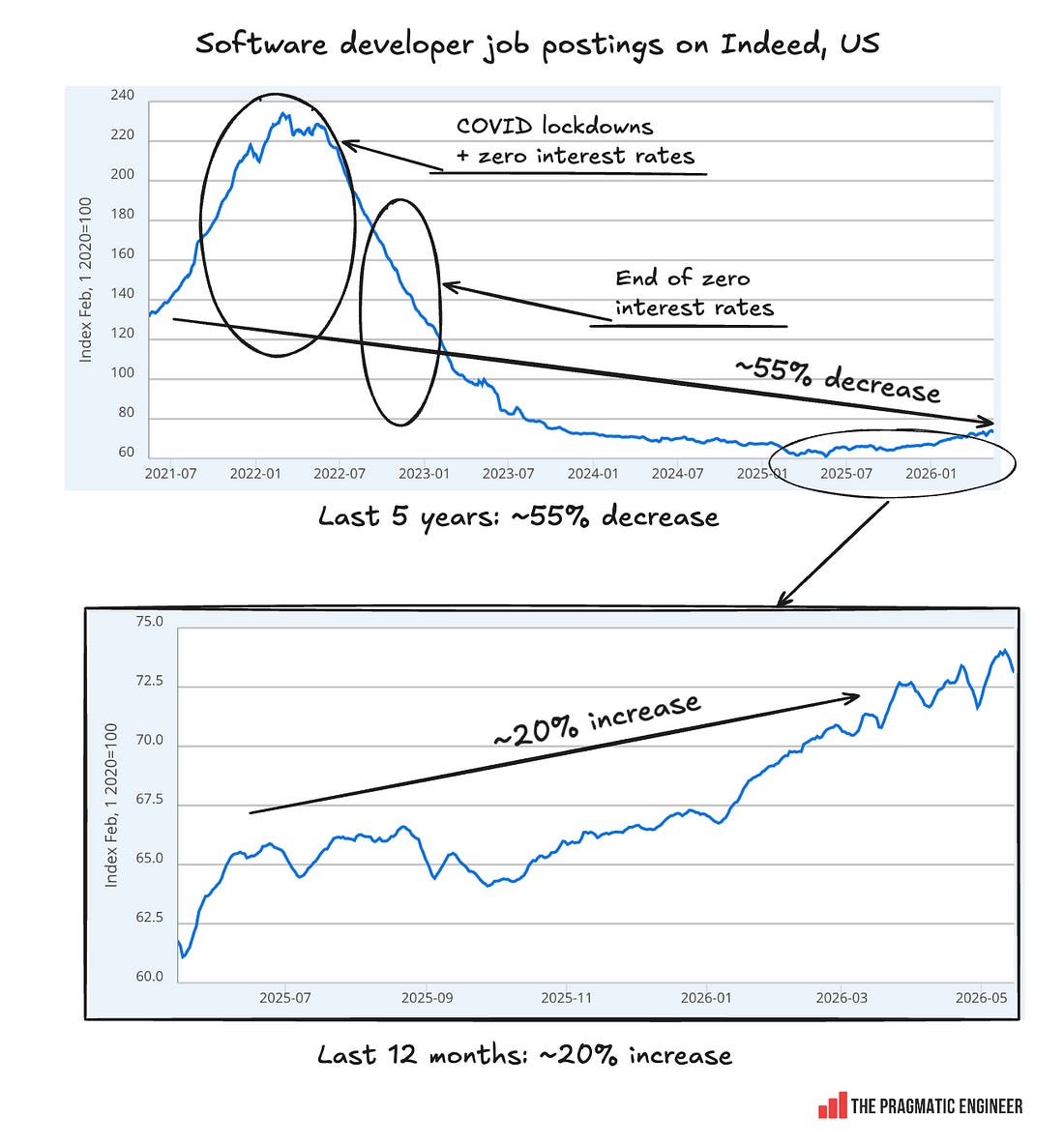
Apple, Google, and TikTok have the most AI engineering roles listed, with observability and fintech companies (Datadog, Ramp, Wiz) showing the fastest headcount growth at 68-94% over two years. The data suggests AI engineering is becoming a baseline skill requirement rather than purely replacing traditional software engineering roles, indicating sustained demand for specialized AI infrastructure and systems expertise.
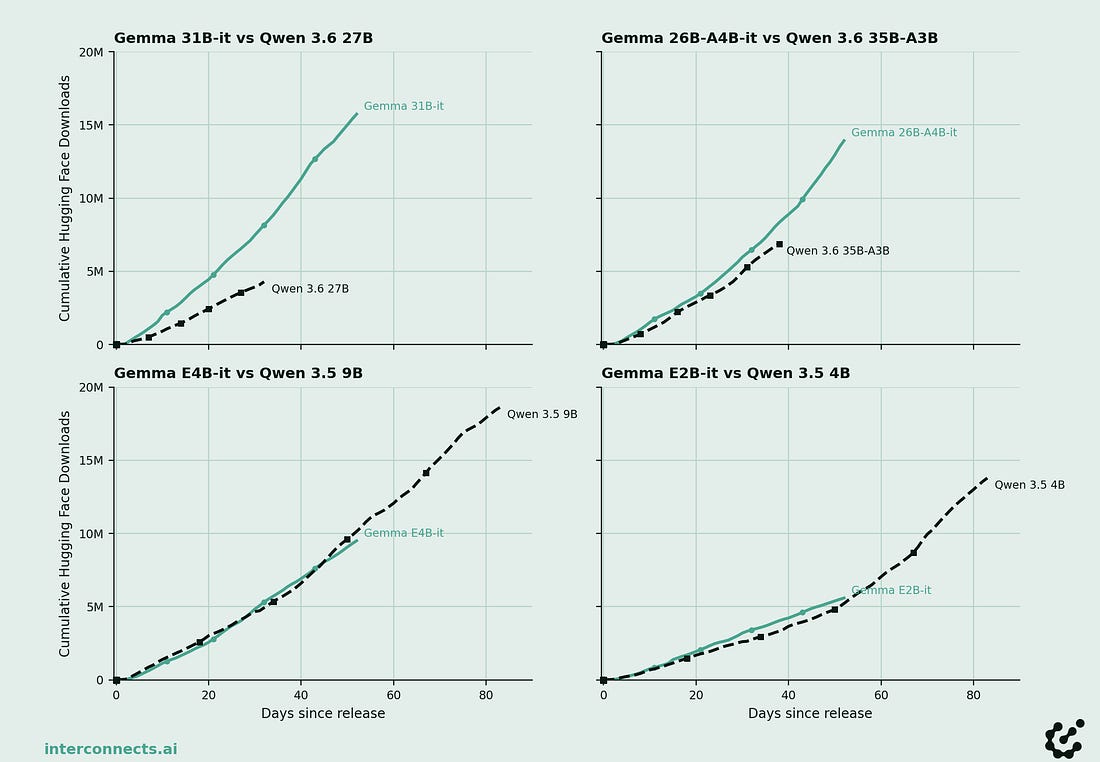
Even with Google's resources, the company has not produced a meaningful competitor to Anthropic's agentic capabilities, suggesting the open-closed performance gap is more about real-world robustness and production reliability than raw benchmark metrics. This indicates frontier labs' agentic tools will remain the primary driver of AI revenue growth for the next 12+ months.
Schneider Electric executives expect only 10% of new AI nodes to adopt 800-volt power delivery by 2030, despite Nvidia's push toward the architecture for its 1 MW "Kyber" rack design. The practical challenges include rack space congestion from power cables and converters—a 1 MW rack would require 32 large power "whips" compared to 8 for a 150 kW rack—forcing a phased approach with sidecars initially and centralized DC distribution solutions not arriving until 2029. This infrastructure constraint directly impacts AI datacenter economics, as power delivery architecture affects cooling costs, efficiency, and total cost of ownership for GPU-dense training clusters.
I read the full press release. Main takeaways:
- Blackstone commits $5B equity to new JV with Google; plans 500 MW TPU capacity online in 2027, scaling significantly after
- Benjamin Treynor Sloss (Google infrastructure veteran, 20+ years) named CEO of new company
- Google supplies TPUs, software, and services; Blackstone provides capital and data center operations expertise
- Positions TPUs as alternative to GPU-dominant cloud compute market; targets enterprises seeking efficiency and choice
- Blackstone's $1.3T AUM and data center scale combined with Google's decade-long TPU development creates significant competitive infrastructure play
I read the full report. Main takeaways:
- OpenAI, Anthropic, and xAI combined controlled ~15-20% of world operational AI compute at end-2025, despite kickstarting the compute boom; top 5 labs likely under 50% of global total
- OpenAI's power capacity grew 3x annually 2023-2025; Anthropic growing even faster; both outpacing industry's ~3x annual growth, suggesting compute consolidation within 2-5 years
- Anthropic's revenue run rate accelerated from $9B to $30B in Q1 2026 (10x+ growth), enabling aggressive compute acquisition (Amazon Trainium, Google, CoreWeave, xAI's Colossus)
- If top two labs maintain 33% faster growth than industry (4x vs 3x annually), they'll reach ~80% of world compute within 5 years, creating hard constraint on scaling
- Global AI capex approaching $1T annually (1% of world GDP); sustaining 4x compute growth would require doubling capex yearly, only feasible if AI dramatically accelerates economic growth
I read the full interview. Main takeaways:
- Google restructured around three core businesses (Search, YouTube, Cloud) powered by unified Gemini infrastructure and centralized AI/infrastructure teams under new leadership (Google DeepMind merger, Amin Vahdat as SVP AI Infrastructure, Koray Kavukcuoglu as chief AI architect).
- Search is undergoing fundamental changes: intelligent search box + Gemini Spark agents enable tasks beyond results; YouTube search now summarizes/indexes videos with direct navigation to relevant segments, extending "Google Zero" dynamics to creator content.
- Pichai explicitly acknowledges ChatGPT forced organizational restructuring and faster decision-making cadence (weekly AI product reviews); he frames AI moment as enabling common infrastructure across all products (Personal Intelligence, Ask Maps, NotebookLM harmonization).
- On timeline: Pichai agrees with Demis Hassabis's "foothills of singularity" framing from I/O keynote; discusses AGI timeline implications without specific dates.
- Organizational philosophy: most decisions aren't consequential—velocity matters more; few decisions (like DeepMind merger) warrant extended deliberation.
I read the full report. Main takeaways:
- 800VDC transition driven by physics: at 600kW+ rack densities, 48-54V distribution requires ~200kg copper per rack and ~12,500A current; 800V reduces current 16.7× and I²R losses ~278×, enabling denser compute
- Four-phase adoption: Phase 1-2 (2026-2028) use disaggregated power racks (sidecars) retrofitting existing AC infrastructure; Phase 3-4 (2029+) move to facility-level HVDC distribution with Solid-State Transformers (SSTs)
- Mt. Diablo reference design (OCP standard) establishes power rack BoM: 415V AC input, rectification to 800VDC, BBU modules for ride-through, capacitor shelves for transient buffering
- SemiAnalysis forecasts ~39GW of 800VDC-powered capacity by 2030; equipment content/MW shifts dramatically across 70+ equipment types and 500+ suppliers
- Hyperscalers (Google, Meta) leading Phase 1 retrofit in 2026-2027 for efficiency gains and future-proofing before 600kW racks become mandatory physics constraint
I read the full article. Main takeaways:
- Schneider Electric expects only ~10% of new AI nodes to adopt 800V DC by 2030, despite Nvidia's Kyber 1MW rack architecture pushing the standard
- 800V adoption will initially use in-rack sidecars (600kW-1MW capacity), with centralized AC-to-800V converters (2-5MW chunks) not arriving until 2029
- At 150kW per rack with 72 GPUs, conventional 48V requires 8 power cables; scaling to 1MW with 144 GPUs would need 32 much larger cables, making low-voltage impractical
- Liquid cooling reduces water consumption dramatically: 100MW Dallas datacenter uses 79 Olympic pools with liquid cooling vs. 161 pools with air/evaporative cooling, while generating 2.52x10^11 tokens vs. 1.99x10^8
- Most new AI datacenters will use mixed voltage architecture with 800V as isolated pockets, not wholesale retrofits