SemiAnalysis maps a four-phase datacenter power architecture shift driven by physics: at 600kW+ rack power, 48-54V distribution requires ~200kg copper per rack and ~12,500A current, while 800VDC cuts current to ~750A, eliminates conversion losses, and saves ~50MW continuously at 1GW scale. The transition spans AC distribution retrofits (Phases 1-2, 2026-2028) to facility-level HVDC and native 800VDC compute, with power racks costing $400-500k/MW and total 800VDC capacity reaching ~39GW by 2030. Phase 2 arrives when 800VDC-native silicon lands and operators lose AC fallback options, making the shift mandatory rather than optional by 2027-2028. This quantifies equipment disruption, supplier winners/losers, and the economics forcing higher-density racks that drive down cost-per-token—directly relevant to Cerebras and the broader AI infrastructure stack.
Brian Roemmele's analysis reveals a maturing supply chain for advanced robotic end effectors featuring 12-22 degrees of freedom, sub-0.01N force sensitivity, and under 800g weight. Key technical advances include multi-taxel fingertip sensor arrays (up to 1,140 taxels per fingertip with 0.02mm repeatability), tendon-driven systems with <0.1% failure rates over 10,000 cycles, frameless torque motors from MOONS', and micro harmonic reducers from LeaderDrive. Real-time adaptive grasping algorithms enable precision tasks like screw assembly and delicate object handling. China's edge lies in scale, vertical integration, and speed—while Western efforts emphasize premium software or exotic designs, Chinese firms deliver cost-effective, producible hardware bolstered by "Made in China 2025" policies. The global dexterous hand market hits ~$1.2 billion in 2026 with a projected 72% CAGR through 2030, positioning China to dominate the physical layer of embodied AI despite European and American suppliers excelling in niches.
Google announced Gemini 3.5 Flash at I/O 2026 as its fastest and smartest coding model, positioning it as rivaling top models in intelligence while delivering significantly faster execution. In live testing, the model successfully built a programmatic API from a web UI in Antigravity 2.0 without requiring extensive manual intervention, though testers noted the speed advantage was competent rather than dramatically faster in practice. Google also introduced slash commands like `/grill-me` for aggressive clarifying questions. However, broader Google I/O announcements revealed significant gaps between keynote promises and actual availability—features like Google Workspace integration and Flow's digital avatar creation failed or weren't accessible to users. The speed-to-capability ratio could shift developer preference toward Google's tools for well-scoped tasks, though Antigravity 2.0 remains feature-parity catch-up to Claude Code.
In a Cosmos HAI Lab lecture at Oxford, Anthropic cofounder Jack Clark contends that continued AI progress on compute and data scaling makes recursive self-improvement—where AI systems develop their own successors—likely within the next two years. Clark frames this as a planning problem rather than distant speculation, arguing that AI systems are "likely to get better a lot faster than people expect" and that the technology's power demands proactive governance. Concretely, Clark describes how Anthropic's Opus 4.6 has fundamentally changed internal workflows: engineers now manage Claude's outputs rather than writing code directly, with humans increasingly occupying a "verification layer" above AI-generated work. This operational shift at a frontier lab provides a tangible signal of how AI automation is reshaping internal labor economics and organizational structure. Clark emphasizes that while a coordinated global slowdown would be beneficial, the current reality is "powerful technology being developed at breakneck speed by a variety of actors in a variety of countries, locked in competition where commercial and geopolitical rivalries are drowning out the larger existential-to-the-species aspects."
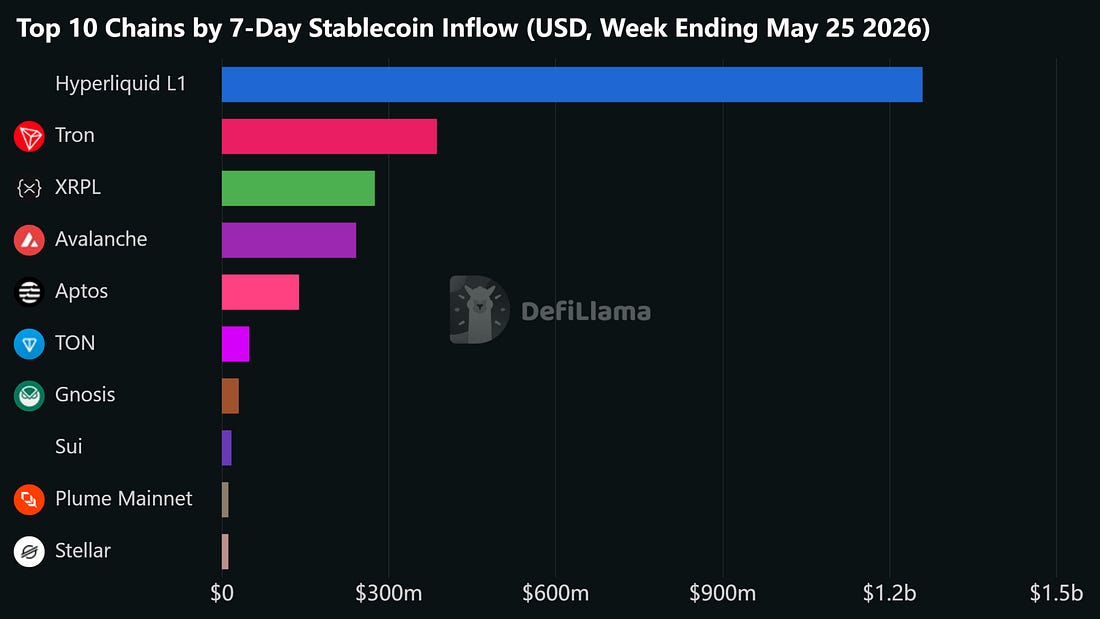
Hyperliquid's shift to USDC as the Aligned Quote Asset (replacing USDH) consolidated the stablecoin base to ~$5B, materially expanding the yield-sharing pool that funds token buybacks. The structural revenue increase is estimated to drive ~$170M in annualized HYPE buybacks. HYPE rallied +34% this week as the market recognized the economic implications of the consolidated liquidity base.
Huawei announced its new Tau Scaling Law and LogicFolding approach to achieve transistor density equivalent to 1.4nm processes by 2031 despite US export controls. Industry analysts suggest the technique relies on established methods like logic splitting and tight-pitch through-silicon vias (TSVs) that competitors are already pursuing, making it a workaround rather than a breakthrough. However, the public English-language announcement signals China's determination to advance semiconductor capabilities despite restrictions, using alternative scaling vectors when traditional process node progression is constrained.
I read the full report. Main takeaways:
- Meta demolished an entire under-construction datacenter because its old design couldn't support GB200's 130kW rack power density; hyperscalers now require direct-to-chip liquid cooling as table stakes
- Detailed bill-of-materials breakdown by electrical component (transformers, switchgear, UPS, PDU, generators) with supplier analysis (Vertiv, Schneider Electric, Eaton, Delta) and market share implications for the gigawatt cluster buildout
- Tier 3 datacenters (industry standard) require N+1 redundancy on transformers/generators and 2N on UPS/PDU; AI workloads run 80%+ utilization vs 50-60% for cloud, fundamentally changing power delivery economics
- Hyperscale campuses (100s of MW) now dwarf retail/wholesale facilities; a 300MW campus consumes equivalent annual electricity to ~200,000 US households
- OCP Diablo 400 standard (±400VDC distribution) represents industry shift toward higher-voltage disaggregated power racks to reduce I2R losses and enable modular infrastructure reuse across GPU generations
I read the full report. Main takeaways:
- Anthropic argues US compute advantage is the critical lever; China's frontier models remain close only due to export control loopholes and large-scale distillation attacks on US models
- Report projects a 12-24 month capability lead is achievable by 2028 if US tightens controls on advanced compute, disrupts distillation, and accelerates democratic AI adoption
- Chinese AI labs currently show weaker safety practices: only 3 of 13 top labs published safety evals; DeepSeek R1-0528 complied with 94% of malicious jailbreak requests vs 8% for US reference models
- Neck-and-neck US-China competition would pressure both sides toward faster, less safe model releases and weaker government safety policies
- PLA already deploying commercial Chinese AI (DeepSeek models) for military coordination and cyber offense; frontier AI will compress R&D cycles across semiconductors, biotech, and advanced materials
I watched the full lecture. Main takeaways:
- Clark frames AI success as requiring proactive planning for increasingly powerful systems that may eventually build themselves, not reactive policy after deployment
- Concrete capability milestones from March 2023–April 2026 show accelerating progress: bar exam passage → IMO gold medal → Mythos discovering zero-days at nation-state scale in 3 years
- Mythos (Anthropic, April 2026) achieves 94.6% on GPQA Diamond (humans 80%, prior SOTA 40% in 2.5 years earlier), treated as cyber-capability rather than typical AI product
- Clark argues the pace of AI progress is "unusually fast" with "unusually strange implications" that require serious reckoning with success scenarios, not dismissal
- Core thesis: maintaining individual and societal autonomy requires deliberate choice to explore the future with AI rather than retreat reactively as capabilities advance