Nvidia reported Q1 data center revenue of $75.2B (up 92% YoY) with net income climbing 211% to $58.3B, raising Q2 guidance to $91B. CEO Jensen Huang attributed the acceleration to "parabolic" demand driven by agentic AI, with hyperscaler revenue ex-China growing 191% YoY. The results underscore Nvidia's entrenched position as compute capacity becomes the binding constraint across the AI infrastructure stack.
Techmeme + Brian Roemmele from The Brian Roemmele Report.
Anthropic disclosed $10.9B expected Q2 revenue (127% sequential growth) with first-ever operating profit of $559M, while simultaneously revealing in SpaceX's S-1 IPO filing that it is paying SpaceX $1.25B per month for compute capacity through May 2029, with plans to expand to Colossus 2 capacity. The deal represents $15B annually and demonstrates the economics of frontier model training at scale. SpaceX's prospectus also detailed Starlink's 10M+ subscribers generating ~$11.4B in 2025 revenue (60%+ of total), Falcon 9/Heavy commanding 80%+ global commercial launch share with 99%+ success rate, and $15.9B in cash reserves positioning the company for continued infrastructure expansion.
Railway announced 3M users with 100K weekly signups while maintaining 70% margins on bare metal infrastructure, achieving a three-month payback period on owned data centers versus cloud rental. The platform completed its first California data center site in nine months (from January 2024 kickoff) and is lighting up three additional regions. Rather than adopting Kubernetes, Railway is building custom orchestration, version control, and content-addressable storage systems optimized for running thousands of parallel agents, treating agents as "the next dominant software species" requiring 1000x improvements in observability and orchestration compared to human-deployed systems. The shift to owned infrastructure was driven by hyperscaler constraints on pricing, service levels, and feature velocity—problems that directly affected Railway's ability to serve customers effectively.
Cursor's newly released Composer 2.5 achieves 79.8% on SWE-Bench Multilingual and matches Anthropic's Opus 4.7 performance on CursorBench 3.1 while operating at $0.50/$2.50 per million tokens versus Anthropic's ~$5/$25 pricing. Despite GitHub Copilot's 20M users versus Cursor's 2M, Cursor generates 4x more revenue per user—a gap attributed not to model commoditization but to Cursor's superior orchestration layer: project context handling, multi-file workflows, and IDE integration. This intents-layer advantage represents the real moat as foundation models commoditize, explaining Cursor's exceptional growth trajectory and positioning the merged entity (post-xAI integration) with credible paths to compete with OpenAI and Anthropic.
Constellation Software's Volaris subsidiary CELCAT reduced development cycles from months to hours through intensive AI adoption, driving organic growth acceleration from 12% to 23% annually. The breakthrough came after a month-long pause in April 2025 for focused learning, after which cycle times compressed from months → weeks → days → hours. This 50x velocity increase unlocked a fundamental product repositioning from "system of record" to "system of action," enabling new capabilities (thinking, prediction, insights) that justify new price points and doubled revenue targets by 2029. The case demonstrates how infrastructure economics shift when velocity increases by orders of magnitude—ideas previously too small or low-ROI to justify engineering time become viable, creating new value categories.
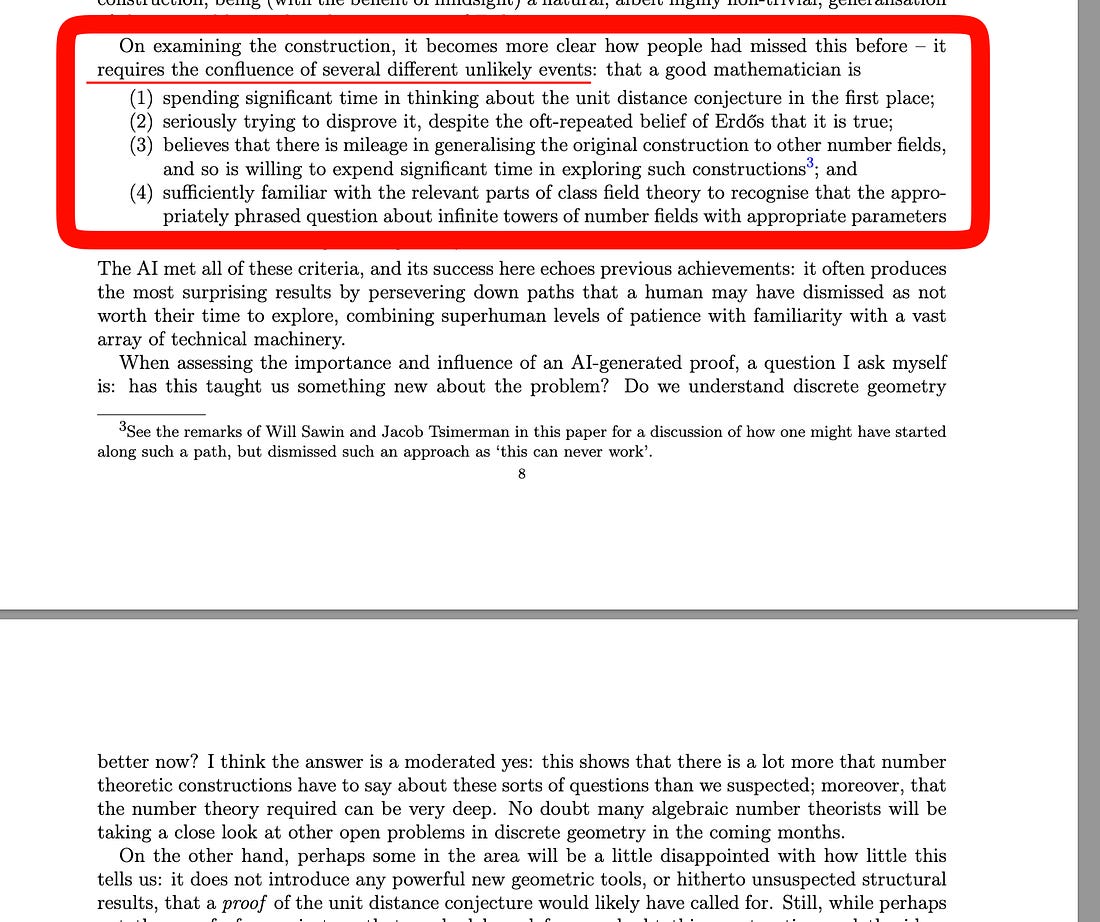
OpenAI's general-purpose reasoning model (speculated to be GPT 5.6 or similar) solved a long-standing discrete geometry conjecture in under 32 hours of compute, producing 125 pages of mathematical reasoning that mathematicians including Timothy Gowers validated as qualitatively beyond prior "AI does olympiad math" results. The breakthrough demonstrates frontier reasoning capability generalizing beyond domain-specific scaffolding, with implications for inference-time scaling as the primary paradigm driving progress in frontier models.
The Linux kernel community officially graduated Rust from experimental status in December 2025, signaling accelerating adoption in kernel and systems code. The move aligns with US Department of Defense regulations pushing agencies away from non-memory-safe languages, with direct implications for infrastructure buildout and language ecosystem dynamics across the systems programming landscape.
I watched the full Constellation Software 2026 AGM supercut. Main takeaways:
- Constellation's decentralized model (hundreds of small businesses, federated decision-making) is being leveraged for AI via Medaxion platform that lets customers build agents across industry/product boundaries without central mandate
- Harris Operating Group (Jeff Bender) reduced development cycle time from months → weeks → days → hours after April 2025 AI learning sprint, demonstrating concrete productivity gains from LLM integration
- Healthcare vertical (Santina) emphasizes data moat: ambient listening to clinical conversations creates new AI-powered value capture opportunities in their system-of-record position
- Management explicitly positions Constellation as one of three strategic acquirers in software, with smaller competitors in 'transient ownership' destined to consolidate toward them over 5-15 years
I read the full interview transcript. Main takeaways:
- Linux kernel development operates on a fixed 9-week release cycle with a 2-week merge window for features, then 7 weeks of stabilization—no product managers, ~4,000 annual contributors coordinated via email and git.
- Monolithic kernel architecture allows Linux drivers to be ~33% smaller than competitors due to code-sharing; the core principle is "never break userspace" to ensure backward compatibility across upgrades.
- ~25,000 lines of Rust already in kernel (mostly bindings); adoption driven by government memory-safety mandates and improved C safety, but resistance from some core developers favoring single-language codebase.
- Stable kernel branches maintained separately with weekly releases; Greg and Sasha Levin manage multiple long-term support (LTS) kernels simultaneously, with backporting to older kernels increasingly difficult due to code divergence.
- ~80% of kernel contributors are paid by employers (companies find it cheaper to contribute than build proprietary OSes); individual contributions offer significant career value demonstrating collaboration and real-world problem-solving.
I read the full incident report. Main takeaways:
- Google Cloud suspended Railway's production account without proactive notice, cascading into 8-hour platform-wide outage affecting dashboard, API, and all workloads across GCP, AWS, and Railway Metal regions
- Single architectural dependency: Railway's edge proxies relied on GCP-hosted control plane API for routing tables; when cache expired, workloads on non-GCP infrastructure became unreachable despite remaining online
- Recovery was extended by GCP's separate restoration of persistent disks, compute instances, and networking (disks ready at 23:54 UTC but networking not restored until 01:30 UTC)
- Secondary cascade: GitHub rate-limited Railway's OAuth/webhook integrations during recovery, blocking logins and builds as retry volume spiked
- Remediation plan: removing GCP from data plane hot path, extending HA database shards across AWS and Metal, implementing true mesh architecture to eliminate single-cloud dependency
I read the full article analyzing SpaceX's public S-1 IPO filing. Main takeaways:
- xAI lost billions in 2025 despite 60% of SpaceX's $20B capital spending directed to AI division; only 22% revenue growth, far below frontier lab benchmarks
- SpaceX has burned $37B+ since inception; lost $4.9B in 2025 on $18B revenue, with Starlink generating >$11B (>50% of revenue)
- Anthropic paying SpaceX $1.25B/month through May 2029 for compute; deal can be exited with 90 days' notice per filing
- SpaceX claims $28.5T TAM with $22.7T attributed to enterprise AI applications; Starship R&D spent $3B in 2025, $930M in Q1 2026
- Musk retains 85.1% voting control post-IPO; compensation package includes up to 1B Class B shares if SpaceX reaches $7.5T valuation and establishes Mars colony with 1M+ inhabitants
I read the full report. Main takeaways:
- OpenAI's reasoning model autonomously solved the 80-year-old unit distance problem in combinatorial geometry, disproving Erdős's conjecture with a polynomial improvement over prior constructions.
- The proof unexpectedly bridges algebraic number theory and discrete geometry, using tools like infinite class field towers and Golod–Shafarevich theory—connections mathematicians had not previously made.
- This marks the first time a prominent open problem central to an active mathematical subfield was solved autonomously by AI, with the proof verified by external mathematicians including Fields medalist Tim Gowers.
- The result demonstrates AI's capability for original mathematical discovery and complex reasoning chains, with implications for AI's role in frontier research across biology, physics, materials science, and engineering.


![AINews] OpenAI GPT-next disproves 80 year old Erdős planar unit distance problem for under $1000](https://www.latent.space/p/ainews-openai-gpt-next-disproves?img=https%3A%2F%2Fsubstack-post-media.s3.amazonaws.com%2Fpublic%2Fimages%2F0ff7bdc0-79ef-49ce-a5c0-f7db89d60637_1098x1582.png&open=false)