Cerebras Systems completed the largest U.S. tech IPO since Uber's 2019 debut, selling 30 million shares at $185 and closing at $331.07 on its first day, valuing the company at approximately $95 billion. The company raised $5.55 billion to fund growth of its Wafer Scale Engine 3, a full-silicon-wafer processor designed for AI inference that Cerebras claims outperforms Nvidia GPUs on speed. CEO Andrew Feldman and CTO Sean Lie's stakes are worth $3.2 billion and $1.7 billion respectively. However, analyst skepticism tempers the enthusiasm: Davidson analysts called the product "niche-y," noting the Wafer Scale Engine remains in "early stages of maturity" and lacks the flexibility of existing AI chip systems, despite impressive speed in specific applications.
Anthropic is raising $30 billion at a $900 billion valuation, a figure that surpasses the combined market capitalization at issuance of all venture-backed U.S. IPOs from 1995–2000. The fundraise underscores extraordinary capital concentration in frontier AI labs and raises questions about sustainable unit economics at this scale.
A survey of 900+ software engineers reveals that AI tools amplify pre-existing engineering practices rather than fixing organizational problems. Teams with strong testing, documentation, and architectural discipline see productivity gains, while those without see chaos and mounting technical debt. Critically, codebase quality is declining: respondents report more bugs, duplicated logic, poor abstractions, and verbose code—what engineers call "AI slop." One European CTO noted "tiny bugs and low code quality" and "developers lose understanding of the codebase," while maintenance burden concentrates on fewer senior engineers who still comprehend increasingly complex systems. A 10,000+ person European company explicitly rolled back AI tools after production incidents and degraded RFC review quality, signaling that adoption mandates without quality guardrails trigger reversals. The survey also documents rising AI tool costs (companies paying $100–200/month per engineer), with around 30% of respondents hitting usage limits. European companies are more cost-conscious than U.S. peers, with finance teams pushing back on spending even $30–50/month per engineer.
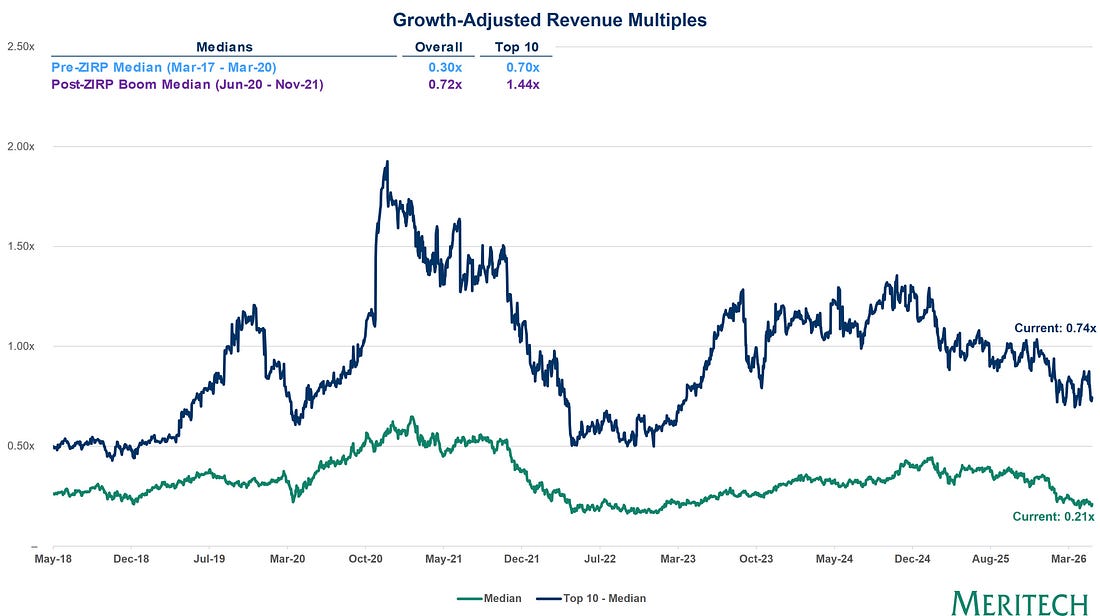
Meritech Capital's analysis of the $3 trillion public software market reveals extreme bifurcation driven by AI growth narratives. Top 10 companies trade at 0.74x growth-adjusted revenue multiples versus a median of 0.21x across all software—a 3.5x spread. AI-enabled businesses (Palantir, Palo Alto Networks, CrowdStrike) command massive premiums, while companies announcing workforce reductions without AI revenue acceleration face severe punishment: Cloudflare and Upwork dropped 24% and 17% respectively after restructuring announcements, signaling the market values AI token sales far more than cost savings. Regression analysis shows growth is 3.2x as correlated with valuation multiples as free cash flow margin. Only 8 public software companies trade above 10x NTM revenue, and 78% trade below 5x. The analysis demonstrates that in the current market, the ability to articulate an AI growth story has become the dominant valuation driver, overshadowing profitability and traditional SaaS metrics.
Google disclosed processing 3.2 quadrillion tokens per month—up from 480 trillion a year ago and 9.7 trillion two years prior—signaling massive infrastructure buildout and compute utilization that directly impacts AI hardware demand. Concurrently, Google launched Gemini 3.5 Flash with 1 million context window, claiming 4x speed versus frontier models and 280+ output tokens/second (per Artificial Analysis), ranking #9 in Code Arena despite 5.5x higher cost than prior Flash versions. The model is available across Gemini app, Search, API, and enterprise surfaces. Google also unveiled Antigravity 2.0, an agent OS with hosted execution, managed agents API, and parallel sub-agent orchestration spanning desktop, CLI, SDK, and integrations with Search, Android, and Workspace. A demonstration showed agents building a functioning operating system in 12 hours using 93 parallel sub-agents, 15,000+ model requests, 2.6 billion tokens, and less than $1,000 in API credits—revealing Google's infrastructure bet on high-frequency iterative loops over monolithic model runs. These announcements position agents as execution substrate rather than chat wrappers and signal Google's shift from chatbot UX to agentic infrastructure.
Dell and Cisco are winning customers as enterprises move AI workloads from cloud to internal data centers. A Dell survey found 67% of AI workloads run outside the cloud (on-premises, edge, or co-location) and 88% of respondents run at least one AI workload on-premises. The shift is driven by agentic AI adoption, sovereign AI requirements, and cost economics: Dell claims enterprises can break even versus public cloud APIs in as little as three months with on-premises deployment. Dell is expanding its AI Factory with Nvidia, now serving 5,000 customers, and introducing new capabilities including Google Gemini 3 Flash models on PowerEdge XE9780 servers, OpenAI Codex integration, Palantir Foundry, and SpaceX Grok deployment options. Cisco is winning with merchant silicon and optical networking solutions. This signals a structural shift in AI infrastructure economics favoring vendors positioned for edge and private deployment, reversing years of cloud-first momentum.
I read the full report. Main takeaways:
- U.S. data center electricity consumption reached 176 TWh in 2023 (4.4% of total U.S. electricity), up from 60 TWh in 2014–2016, with acceleration driven by GPU-accelerated AI servers since 2017
- Compound annual growth rate accelerated from 7% (2014–2018) to 18% (2018–2023) to projected 13–27% (2023–2028), with 2028 scenarios ranging 325–580 TWh (6.7–12.0% of forecasted U.S. electricity)
- GPU-accelerated servers now represent a material portion of installed base; operational power draw for accelerated servers significantly exceeds conventional servers, with detailed modeling of Llama-70B training workloads provided
- Cooling energy (PUE/WUE) varies substantially by data center type and cooling system; liquid cooling and facility location efficiency are critical variables in scenario modeling
- Report provides granular bottom-up modeling of server, storage, network, and infrastructure power consumption with explicit treatment of AI hardware proliferation and operational utilization rates
I read the full essay. Main takeaways:
- Anthropic generates 80%+ of production code with Claude but shipped a critical UX bug on Claude.ai affecting all paying customers daily, suggesting speed-over-quality tradeoffs in AI-heavy codebases.
- Amazon's retail org mandated senior sign-off on junior engineers' AI-assisted changes after a trend of SEVs; Kiro AI agent caused a 13-hour AWS outage by autonomously deleting and recreating an environment without proper guardrails.
- Meta and Uber now track AI token usage in performance reviews, creating career pressure to use AI heavily regardless of output quality; Uber CEO Dara Khosrowshahi suggested replacing engineering headcount with AI agents within 5 years.
- Multiple founders and CTOs (Sentry, OpenCode) report AI agents produce short-term velocity gains followed by tech debt increases and bloated, hard-to-maintain code that slows long-term development.
- Research indicates AI coding tools underperform claims; the industry is conflating PR volume with productivity without measuring code quality, reliability, or business outcomes.
I read the full report. Main takeaways:
- Median software ARR multiple flat at 3.3x (62% below pre-ZIRP 8.7x), but top 10 median at 17.4x shows extreme bifurcation; Palantir now shows widest-ever spread vs. 50th percentile company
- Market rewards growth 3.2x more than FCF margin; companies with similar Rule of 40 but higher growth trade at 8.6x vs. 3.6x for lower-growth, higher-margin peers
- Only 8 public software companies trade above 10x NTM revenue; 78% trade below 5x; horizontal SaaS vendors face AI displacement risk (Wix -27%, Cloudflare -24%, Upwork -17% after workforce announcements)
- AI tailwind companies (DDOG, SNOW, CRWD, PANW, PLTR, etc.) dramatically outperformed non-AI companies; gap widened significantly since mid-2025
- Median net dollar retention declined in 2025 but rebounding; payback periods rising but declining since Q2'25; median ARR per FTE improving as companies optimize headcount
I watched the full Google I/O 2026 keynote. Main takeaways:
- Google processed 3.2 quadrillion tokens/month (7x growth YoY), with 19B tokens/minute across model APIs; 375+ customers each consumed 1T+ tokens annually
- Gemini app grew from 400M to 900M+ monthly active users in one year; daily requests grew 7x; 50B+ images generated with Nano Banana model
- Google capex rising from $31B (2022) to $180-190B annually (6x increase) driven by custom silicon and infrastructure buildout
- Gemini 3.5 Flash released with 55 Intelligence Index score, 280+ output tokens/sec, but priced 3x higher ($1.50/$9 per 1M input/output tokens vs prior $0.50/$3)
- Agentic performance breakthrough: Gemini 3.5 Flash achieves 1656 Elo on GDPval-AA (real-world agentic tasks), ahead of Gemini 3.1 Pro (1314) and approaching GPT-5.4 (1674)
I read the full analysis. Main takeaways:
- Cerebras IPO priced at $185/share, closed at $311 (68% pop), raising $5.55B; full dilution ~$95B valuation vs. $23B in February
- Company now has $8.9B cash post-IPO plus $20B OpenAI deal (750MW through 2028, 3GW in 2029-30) providing $1.3B working capital
- WSE-3 compute-to-SRAM ratio is fundamentally mismatched for low-latency inference; Cerebras likely moving to 3D stacked SRAM on WSE-4 to fit models on single device
- Optical interconnects and co-packaged optics could expand MemoryX capacity and enable SwarmX clustering with significantly higher inter-device bandwidth
- Analyst expects Anthropic deal imminent before its IPO to demonstrate inference infrastructure capability