Multiple flagship open models launched this month—DeepSeek V4, Gemma 4 (under new Apache 2.0 license), Kimi K2.6, GLM-5.1, and MiMo 2.5—with CAISI evaluation data showing open models lag U.S. frontier but the gap is stabilizing rather than widening. Google's shift of Gemma 4 to Apache 2.0 eliminates custom license interpretation challenges that previously complicated enterprise deployment. This matters directly for infrastructure economics and competitive positioning: open alternatives are becoming viable for cost-sensitive applications, and licensing clarity could accelerate adoption velocity for organizations evaluating open alternatives to proprietary offerings.
Circle transferred USDH brand assets to Coinbase on May 14, formalizing Coinbase as treasury deployer while Circle handles technical minting/redemption and simultaneously disclosed plans to stake 500,000 HYPE toward becoming a validator. This removes regulatory tail risk by converting Hyperliquid's largest stablecoin float ($5B, doubled YoY) into fee-and-treasury relationships with the two most regulated U.S. crypto entities. Bitwise launched the Hyperliquid ETF (BHYP) on May 15 with 0.34% sponsor fee and in-house staking, positioning the chain with regulated equity wrapper, regulated stablecoin rails, and the most efficient perps order book. Hyperliquid processed $2.9 trillion in trading volume in 2025 (up 400% YoY), commands ~60% of all onchain derivative open interest globally, and processes ~200,000 orders per second.
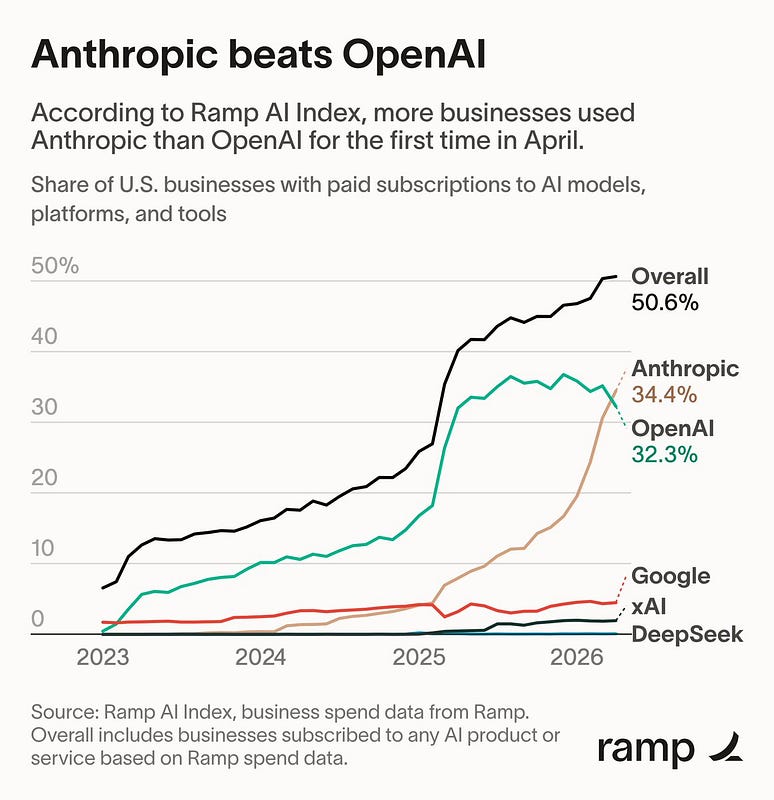
Ramp AI Index data shows Anthropic has overtaken OpenAI in U.S. business adoption as of April 2026 (34.4% vs. 32.3% market share), signaling a major shift in competitive positioning in the most economically valuable customer segment. CFO Krishna Rao disclosed that customer spending increased by a factor of five year-over-year, with 90% of finance reporting now AI-driven and Cowork growing faster than Claude Code (which hit $1B in six months). The company's revenue trajectory has accelerated from $250M two years ago to a $50B annualized run rate, demonstrating explosive enterprise adoption and pricing power. Rao emphasized that Anthropic uses three chip platforms (Amazon Tranium, Google TPUs, Nvidia GPUs) fungibly and has invested heavily in orchestration layers to achieve what he claims is the most efficient compute utilization among frontier labs—spending 30-40% of his time on compute allocation despite exponential business growth.
Microsoft and OpenAI are dissolving their revenue-sharing arrangement, allowing OpenAI to work with other resellers while Microsoft gains improved terms on AI access. Despite Microsoft's $13B investment generating over $30B in revenue over two years, the split reflects structural tensions and suggests OpenAI's strengthened negotiating position.
Caitlin Kalinowski (former head of robotics at OpenAI, hardware lead at Apple and Meta) warns of coming memory cost increases and advises startups to lock in pricing now. This signals potential margin compression across AI hardware infrastructure with direct implications for the economics of training clusters and edge AI deployment.
I read the full essay based on on-the-ground reporting from 14 Chinese AI labs. Main takeaways:
- Chinese labs extract 4-7x more intelligence per unit of compute than naive scaling predictions suggest, despite 2-3 year hardware disadvantage vs US
- Chinese open-source models only 6-8 months behind US frontier despite 8x compute gap; DeepSeek V4 Pro costs 11-28x less per token than Anthropic's Opus 4.6 while maintaining competitive capability
- US labs (OpenAI, Anthropic, Google, Meta, xAI) concentrate training compute; China has 1000+ labs training frontier models, fragmenting the compute pool further
- Chinese inference pricing ($0.43-$1.00 per million input tokens) vs US ($4.73+ for Opus) reflects both efficiency gains and willingness to accept lower margins; MiniMax reports 70% enterprise margins despite aggressive pricing
- Export controls inadvertently forced Chinese labs into ruthless efficiency culture; leading local models are almost all Chinese open-source (Qwen, DeepSeek R1 distilled variants), with only Google Gemma as notable US open-source alternative
I read the full NIST evaluation report. Main takeaways:
- DeepSeek V4 Pro lags U.S. frontier by ~8 months on aggregate capability using Item Response Theory across 16 benchmarks and 35 models
- On CAISI's pre-committed benchmark suite, V4 underperforms on reasoning/agentic tasks (ARC-AGI-2: 46%, PortBench: 44%, CTF-Archive-Diamond: 32%) vs. U.S. models
- DeepSeek V4 costs 53% less to 41% more than GPT-5.4 mini depending on benchmark, with cost parity on 5 of 7 evaluated benchmarks
- V4 achieves Elo 800 vs. GPT-5.4 mini's 749 on aggregate, but this masks domain-specific weaknesses in reasoning tasks not featured in DeepSeek's own benchmarks