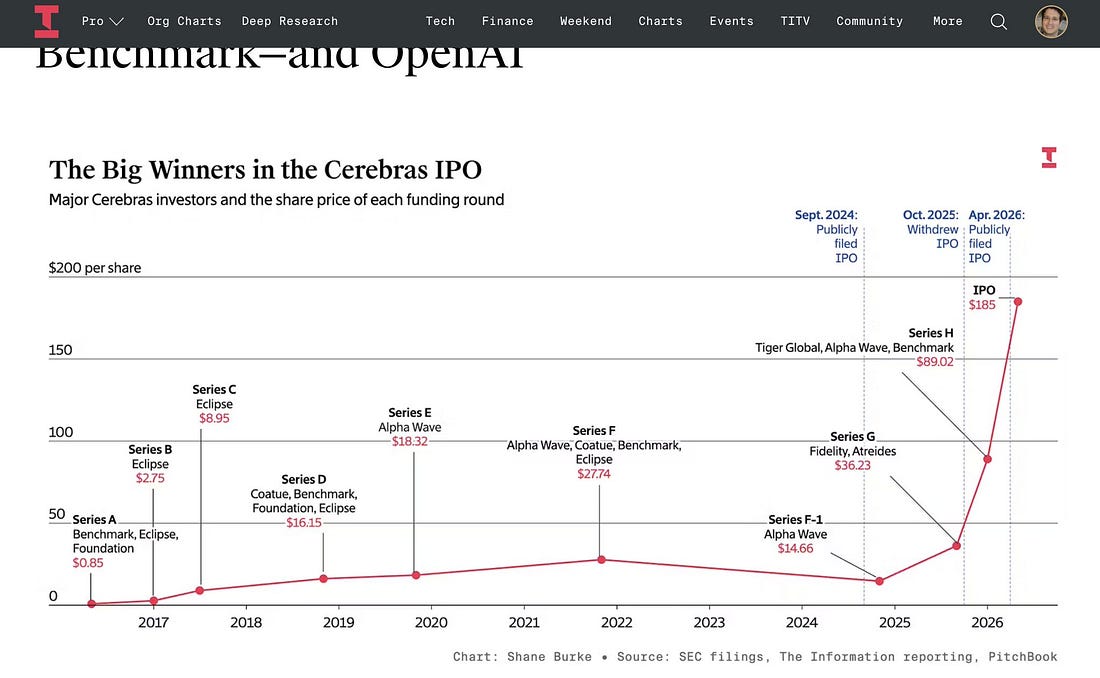
Cerebras Systems doubled on market open at $56B valuation after raising $5.5B on day one, with shares pricing at $180 following 20x oversubscription (up from $115 private pricing). The company closed at $280, reaching a $60B market cap. CFO Bob Komin confirmed Cerebras is already serving trillion-parameter models including OpenAI's internal 5.4 and 5.5 workloads, validating a decade-long contrarian thesis around custom silicon for inference infrastructure at a moment when the market is repricing around compute scarcity and frontier model serving economics. The IPO sets a high bar for upcoming AI infrastructure plays and signals intense institutional appetite for non-NVIDIA architectural alternatives.
CFO Krishna Rao disclosed that Anthropic has achieved $30B run-rate revenue with 120x growth over two years, driven by Fortune 10 companies expanding Claude spending dramatically despite flat pricing—a signal of strong product-market fit and value capture. The company has raised approximately $75B and committed to $100B+ in compute, underscoring the capital intensity and economic moat of frontier AI. This growth trajectory, combined with disclosed customer concentration and spending expansion, reflects both Claude's competitive positioning and the infrastructure capital requirements now defining AI economics.
A Trump delegation including Nvidia CEO Jensen Huang and Elon Musk negotiated AI chip exports and rare earth metals access in Beijing, securing approval for Nvidia to sell H200s to China as part of broader trade discussions covering tariffs and supply chain dependencies. Given that China controls 90% of global rare earth supply and represents 30–40% of Nvidia's incremental revenue, these negotiations carry major implications for AI infrastructure buildout economics and geopolitical constraints on chip distribution.
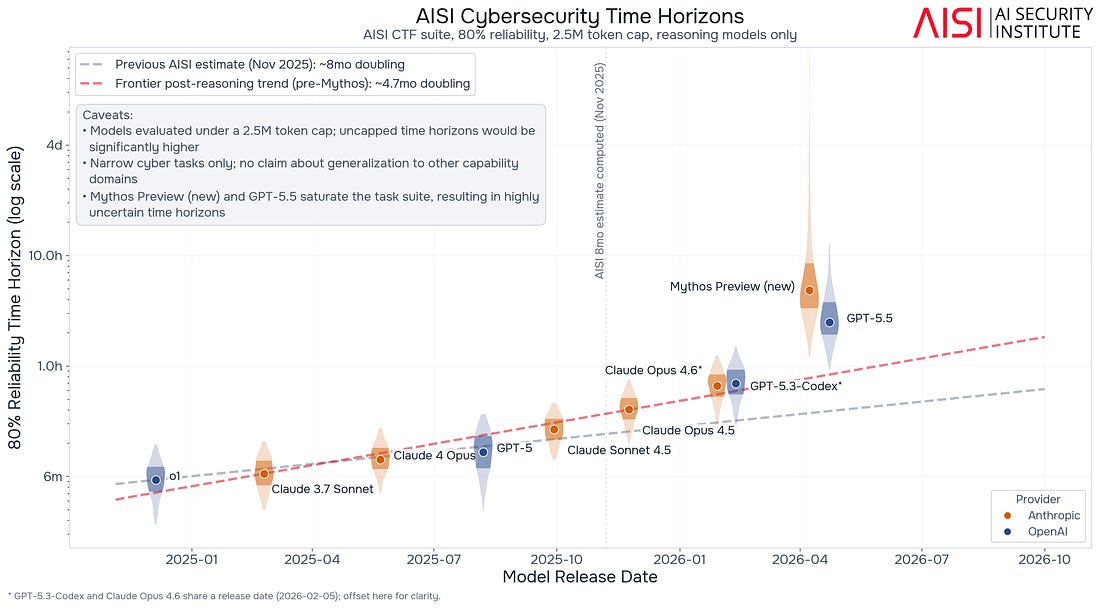
AISI data shows frontier models' cyber attack reliability has doubled every 4.7 months since late 2024, with Claude Mythos Preview and GPT-5.5 now performing so well that success rates exceed measurement capacity. Palo Alto Networks reports that a 50% improvement in coding efficiency represents a threshold where AI crosses from assistant to autonomous operator, compressing attack cycles from hours to 25 minutes. This acceleration in both capability and measurement saturation signals a qualitative shift in AI-enabled cyber risk.
OpenAI has reorganized product leadership with Greg Brockman as head of strategy, placing Theirry Sottiaux in charge of core product/platform (described as a "super app" direction), Nick Aturley on enterprise, and Ashley Alexander on consumer, while Vijay Eraji continues leading infrastructure and scaling products. The reshuffle signals a strategic pivot toward integrated consumer and enterprise platforms rather than fragmented product lines.
Anthropic reset 5-hour and weekly rate limits for Claude developers, likely responding to increased compute availability or competitive pressure. Internal metrics reportedly show $45B ARR by end of May, with domain-specific advantages in software engineering where Claude/Mythos is perceived as meaningfully stronger than GPT-5.5 in some use cases. The rate-limit reset and valuation signals ($900B) reflect intensifying inference economics competition.
CME Group and Intercontinental Exchange are pushing US regulators to impose federal oversight on Hyperliquid, citing its offshore, lightly-regulated environment and vulnerability to market manipulation and sanctions evasion. The lobbying effort signals that Hyperliquid's on-chain perpetuals venue has grown large enough to threaten the incumbents' derivatives dominance.