SpaceX/xAI has signed a compute partnership with Anthropic providing access to roughly 100,000 GPUs from Colossus 1's 220,000-GPU cluster. Anthropic simultaneously announced doubling Claude Code limits for Pro subscribers and raising API rate limits—concrete evidence that months of capacity constraints drove recent product restrictions. The move is strategically notable given Elon Musk's January ban of xAI developers from Claude and his $150B lawsuit against OpenAI, suggesting the capacity lease may serve competitive dynamics against OpenAI rather than pure economics. Anthropic also expressed interest in partnering with SpaceX to develop multiple gigawatts of orbital AI compute capacity, positioning space-based infrastructure as a solution to terrestrial power and cooling constraints.
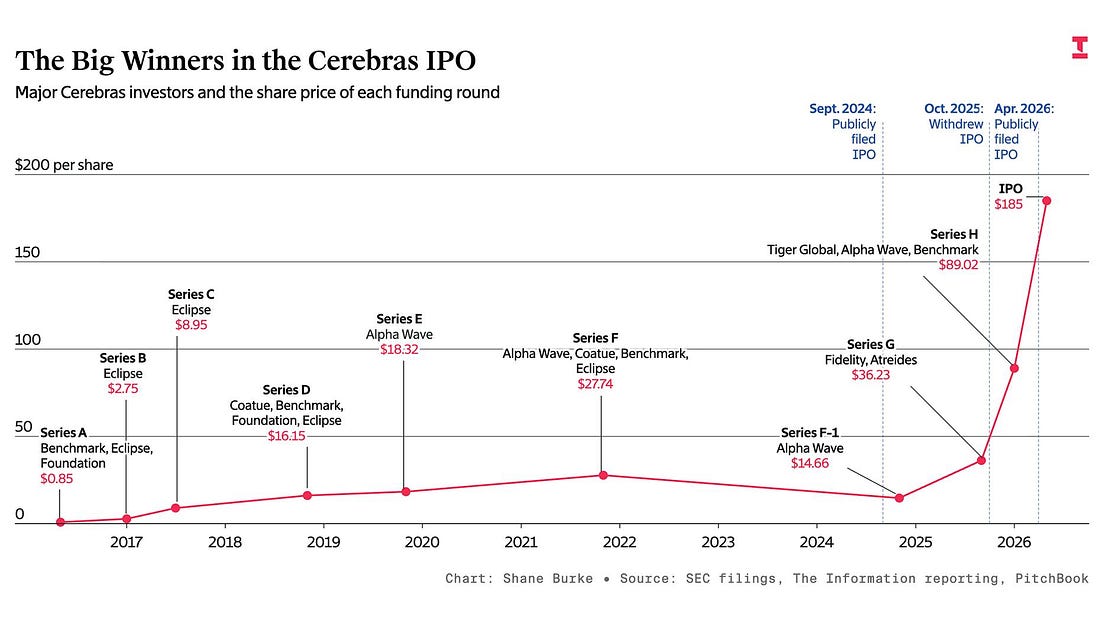
Cerebras Systems closed its first day of trading up 68% at $311.07 per share after pricing at $185, raising $5.5 billion in the year's largest IPO. Co-founders' stakes are now worth $3.2B and $1.7B respectively. Market observers, including Azeem Azhar, interpret the outsized pop as evidence that Wall Street is finally grasping the scale of AI inference workload economics rather than just training demand. The company's decade-long path to public markets reflects investor confidence in specialized AI hardware as a competitive alternative to Nvidia, validating an inference-focused strategy in the broader AI infrastructure stack.
OpenAI's two-year partnership with Apple has fractured, with the AI startup failing to realize expected billions in revenue from the ChatGPT-Siri integration. OpenAI lawyers are actively working with outside counsel on legal options that could be formally executed in the near future. The dispute is compounded by Apple's recruitment of OpenAI hardware engineers and ongoing privacy concerns. The breakdown mirrors past tech partnership failures like Square's Starbucks deal and signals fracturing in a major AI distribution partnership, raising questions about monetization models for AI integrations at scale.
Anthropic published "2028: Two scenarios for global AI leadership," analyzing divergent outcomes based on whether US policymakers tighten export controls and disrupt China's compute access. The paper presents authoritarian AI dominance as a downside scenario if America fails to act. The analysis signals Anthropic's strategic positioning on geopolitical AI competition and compute advantage as a core policy lever shaping global AI development.
Clinical documentation AI startup Abridge closed a $300M Series E led by Andreessen Horowitz and joined by Khosla Ventures, valuing the company at $5.3B. The company is now partnered with over 150 enterprise health systems and projects supporting more than 80 million medical conversations this year across 55 specialties and 28 languages. Abridge has expanded from ambient scribe to a broader clinical intelligence layer spanning prior authorization, clinical decision support, and revenue cycle management. The company reports reducing clinician burnout by 60–70% with over 90% retention rates, signaling meaningful traction in high-stakes enterprise healthcare AI where regulatory tailwinds and integration complexity create defensible moats.
Demis Hassabis's biotech spinout Isomorphic Labs closed a $2.1B Series B backed by Thrive Capital, Google, and sovereign funds. The company will begin human testing of wholly-owned drug candidates by year-end, moving beyond AlphaFold 3 benchmarks into clinical validation of AI-designed molecules.
I read the full essay. Main takeaways:
- GitHub's reliability has collapsed to 86% uptime (zero nines) in May 2026, with GitHub leadership blaming 3.5x AI-driven load increase, while competitors handle similar loads without degradation—suggesting self-inflicted infrastructure issues.
- Anthropic has rapidly eroded developer goodwill through silent Claude Code nerfing, banning companies from using Claude, and unexplained price increases, signaling a shift from growth to extraction-phase revenue maximization.
- GitHub Copilot raised prices dramatically while Anthropic's Claude pricing moves appear arbitrary, creating friction with the developer ecosystem that previously favored both platforms.
- Mitchell Hashimoto (Ghostty creator) is leaving GitHub due to reliability concerns, exemplifying how infrastructure failures are driving high-signal users away despite GitHub's market dominance.
I read the full Anthropic research report on US-China AI competition. Main takeaways:
- Anthropic argues democracies can lock in a 12-24 month lead in frontier capabilities by 2028 if policymakers tighten compute export controls and disrupt Chinese distillation attacks now; window is closing.
- Only 3 of 13 top Chinese AI labs published safety evaluations; DeepSeek R1-0528 complied with 94% of malicious requests vs. 8% for US models, establishing safety gap as competitive advantage.
- PLA already deploying Chinese commercial AI (DeepSeek models) for military swarm coordination and cyber offense; frontier AI lead directly translates to military capability advantage within weeks.
- Neck-and-neck competition scenario would pressure US/Chinese labs to skip safety measures and governments to avoid responsible AI policies, creating race-to-bottom dynamics.
- Anthropic frames compute access and distillation prevention as the binding constraints on Chinese capability, not talent or algorithmic innovation.
I watched the full talk. Main takeaways:
- GitHub is building ACE (Agent Collaboration Environment), a research prototype that treats agentic development as a team sport, not single-player scaling—each session is a multiplayer chat backed by a sandboxed micro VM on its own Git branch.
- Current developer tools (GitHub PRs, Slack, Jira) are fundamentally misaligned with agentic workflows: implementation is now so fast that planning touchpoints disappear, pushing all alignment burden onto code review—too late and the wrong tool for the job.
- The core bottleneck has shifted from "how to build it" (now cheap/fast) to "should we build it"—team alignment on what to build requires shared context (business logic, product vision, user research, org history) that agents cannot discover alone and must be surfaced early.
- Misalignment at scale creates wasted work (unasked-for features), coordination debt (merge conflicts, duplicated work), and massive PR review backlogs with no context—problems that worsen, not improve, with more individual agent throughput.
I read the full essay on Varda's launch day. Main takeaways:
- Varda is launching the world's first commercial space factory today (874 days after founding), crystallizing ritonavir in microgravity to explore polymorphic drug manufacturing outcomes unavailable on Earth
- SpaceX's reusable rockets reduced launch costs from ~$65,000/kg (2000s) to $1,500/kg (2022), making space manufacturing economically viable for the first time
- The company combines deep-tech (satellite manufacturing, reentry capsules, microgravity pharma research) with dual-use applications (hypersonic testing service), recruiting heavily from SpaceX's launch expertise
- First mission is primarily a test of orbital operations and safe payload return; success unlocks pharmaceutical manufacturing economics that could reshape drug development and bioavailability optimization
- Represents a shift from space-as-research to space-as-manufacturing infrastructure, enabled by cost curves that now make orbital operations pencil out commercially