Nathan Lambert reports that Chinese AI researchers demonstrate greater willingness to deprioritize non-critical work for overall model optimization, contrasting with U.S. labs where career advancement incentives and public visibility create internal friction—Lambert notes Meta's Llama organization "collapsed under the political weight" of such dynamics. This cultural difference, combined with heavy reliance on students who lack prior AI hype cycle baggage, appears to accelerate adoption of new paradigms (MoE scaling → RL → agents). Beyond organizational culture, non-AI-native Chinese firms like Meituan, Xiaomi, and Ant Group are building proprietary models—a pattern absent in U.S. equivalents that simply purchase services. This "build-not-buy" mentality extends to data infrastructure, where Chinese labs report domestic data vendors are poor quality and prefer in-house RL environment construction, mirroring Western labs' $100M+ annual data spend but through different organizational structures.
GitHub experienced a 3.5x load spike from AI agents that broke core infrastructure and forced months of outages, dropping to 86% uptime in April 2026 (zero nines), yet the company didn't begin capacity planning until October 2025—months after load started spiking. CTO Vladimir Fedorov acknowledged the crisis is "existential" and announced GitHub will migrate entirely to Azure within 24 months, deprioritizing all feature work to execute the move. By February 2026, GitHub revised its scaling target from 10x to 30x, suggesting it was caught flat-footed despite industry-wide warnings about AI's infrastructure impact. The severity is underscored by high-profile defections: Mitchell Hashimoto, GitHub user #1299 since 2008 and HashiCorp founder, documented nearly every day in April with outages preventing PR reviews and shipping code, citing the platform as unfit for professional work. Third-party uptime tracking shows GitHub averaged 2-3 hours of daily downtime over 90 days, yet competitors like GitLab, Bitbucket, Vercel, and Linear maintained reliability despite similar AI-driven load increases—a concrete signal that GitHub's infrastructure decisions, not universal AI demand, caused the collapse.
Real on-chain metrics show the x402 micropayment protocol has processed 180M+ agentic transactions since October 2025 with $47.5M volume across 5K merchants, with Coinbase's Base settlement capturing 92.8% of agentic payments and 99.8% of agentic payment volume through x402 protocol infrastructure. This concrete adoption signal matters because it reframes Coinbase from cyclical brokerage to AI-native payments infrastructure: the company controls a durable USDC distribution agreement (50% revenue share with Circle) and dominance in Base settlement, with estimated $4.25B in annual agentic commerce revenue alone by 2031. Agents are settling in USDC on Base at sub-cent economics that card rails cannot support, suggesting the infrastructure for machine-to-machine commerce is already operational and scaling.
Anthropic CEO Dario Amodei disclosed the company saw "crazy" 80x annualized growth in revenue and usage despite planning only ~10x growth, calling it "too hard to handle"—a concrete signal of demand intensity that dwarfs typical AI company trajectories and suggests severe compute constraints ahead.
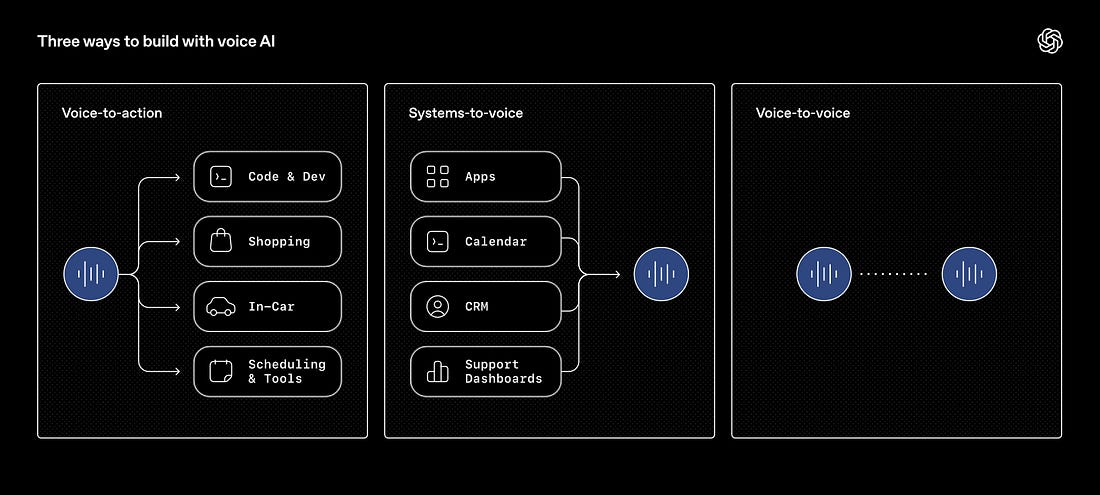
OpenAI launched three new streaming audio models (GPT-Realtime-2, GPT-Realtime-Translate, GPT-Realtime-Whisper) with GPT-Realtime-2 achieving 96.6% on Big Bench Audio, up ~15 percentage points versus the prior version, supporting 128K context (up from 32K), tool use with audible transparency, interruption recovery, and adjustable reasoning effort (minimal through xhigh). This matters because voice agents shift from "speech I/O wrappers" to full-duplex, stateful, reasoning systems capable of handling real customer support, translation, and hands-free workflows.
Genesis demonstrated robots performing complex bimanual tasks like egg cracking, Rubik's cube solving, and wire harnessing using a foundation model trained on 200,000+ hours of multimodal data, paired with a custom data-collection glove and 20-DOF robotic hand. Most demo tasks required under one hour of task-specific robot data, suggesting efficient post-training on small datasets after general model pretraining. The system is designed as a full-stack solution addressing the embodiment gap between human and robot hands through hardware co-design, high-fidelity control, and human-centric data collection—representing meaningful progress toward generalizable robotic systems by treating manipulation as a system problem rather than a pure model training problem.
Jamin Ball presents a novel AGI definition based on when compute energy consumption exceeds human energy consumption, modeling US data center growth from 40GW today to 600GW by 2030 and crossing the 22,000 TWh threshold in 2033. This is significant as a quantitative framework for thinking about AI infrastructure scaling and the physical limits of buildout.
I read the full essay. Main takeaways:
- Anthropic reports 90% of Claude Code's own codebase is written by Claude Code, with 40% usage spike on Sonnet 4 launch and 160% userbase growth in following month
- Windsurf claims ~95% of its code written using its own Cascade agent; Cursor estimates 40-50% of its codebase AI-generated
- Google is taking "slow and steady" approach with AI in Cider IDE and Critique code review, preparing internally for 10x more code shipped to production
- Amazon Q Developer is heavily incentivized across SDEs with free Pro tier access, but adoption and productivity gains remain unclear from engineering feedback
- Interviews with seasoned engineers (Armin Ronacher, Martin Fowler, Kent Beck, Simon Willison) reveal skepticism about AI tool maturity despite vendor claims of 30% code generation
I read the full co-written essay on World Models. Main takeaways:
- World Models reduce dynamic, computationally expensive simulations to fixed-cost neural network forward passes by learning action-conditioned state transitions from video, solving a critical robotics bottleneck where traditional engines scale poorly with scene complexity.
- General Intuition, World Labs ($1B raised), and AMI ($1.03B raised) are competing on fundamentally different architectural approaches to World Models, with the field still lacking agreed definitions but unified conviction that physical world control runs through this paradigm.
- Action-conditioning acts as compression for predicting future states; each action carries sufficient information to unroll dynamics until the next action updates the environment, enabling interactive planning at predictable compute costs that traditional simulation engines cannot match.
- The essay positions World Models as a foundation model class potentially more powerful than LLMs for spatial-temporal reasoning and embodied AI, contrasting lucid dreams (action-responsive) with passive video models (observation-only).
- Jim Fan (NVIDIA) predicts 2026 will mark the first year Large World Models lay real foundations for robotics, moving beyond current hype around AI video generation toward genuine multimodal AI progress.