Andy Jassy disclosed that AWS's chips division (Trainium and Graviton) would generate $50B in annualized revenue if sold as a standalone business, with 40% quarter-over-quarter growth and triple-digit year-over-year expansion. Trainium 2 delivers 30-40% better price-performance than comparable GPUs and is nearly fully subscribed through Trainium 4, while Graviton is now used by 98% of the top 1,000 EC2 customers. The disclosure signals AWS's ability to capture AI infrastructure economics directly and reduce dependence on Nvidia, though the disclosed performance gains appear modest versus Nvidia's generation-over-generation improvements (Nvidia claims roughly 2x performance/$ from Hopper to Blackwell for training).
Intel's Q1 2026 earnings beat consensus EPS by 29x ($0.29 vs $0.01) with data center revenue up 22% year-over-year, while CFO David Zinsner disclosed unmet CPU demand "starts with a B." Server CPU lead times have stretched to six months with prices up 20% since March, and major AI infrastructure players (Google, Nvidia, Tesla) have locked in multi-year Intel CPU commitments over the past 90 days. The surge reflects a fundamental shift in AI infrastructure economics as agent-driven inference workloads require CPU-based orchestration that GPUs handle poorly. ARM estimates the AI agent era will require 4x more CPU cores (120M per GW vs. 30M today), with data center CPU-to-GPU ratios collapsing from 1:8 toward 1:1 in agentic deployments. Intel is the only Western hyperscaler-grade CPU supplier positioned to meet this demand, though Wall Street consensus price targets sit 30% below current trading levels, suggesting significant upside remains.
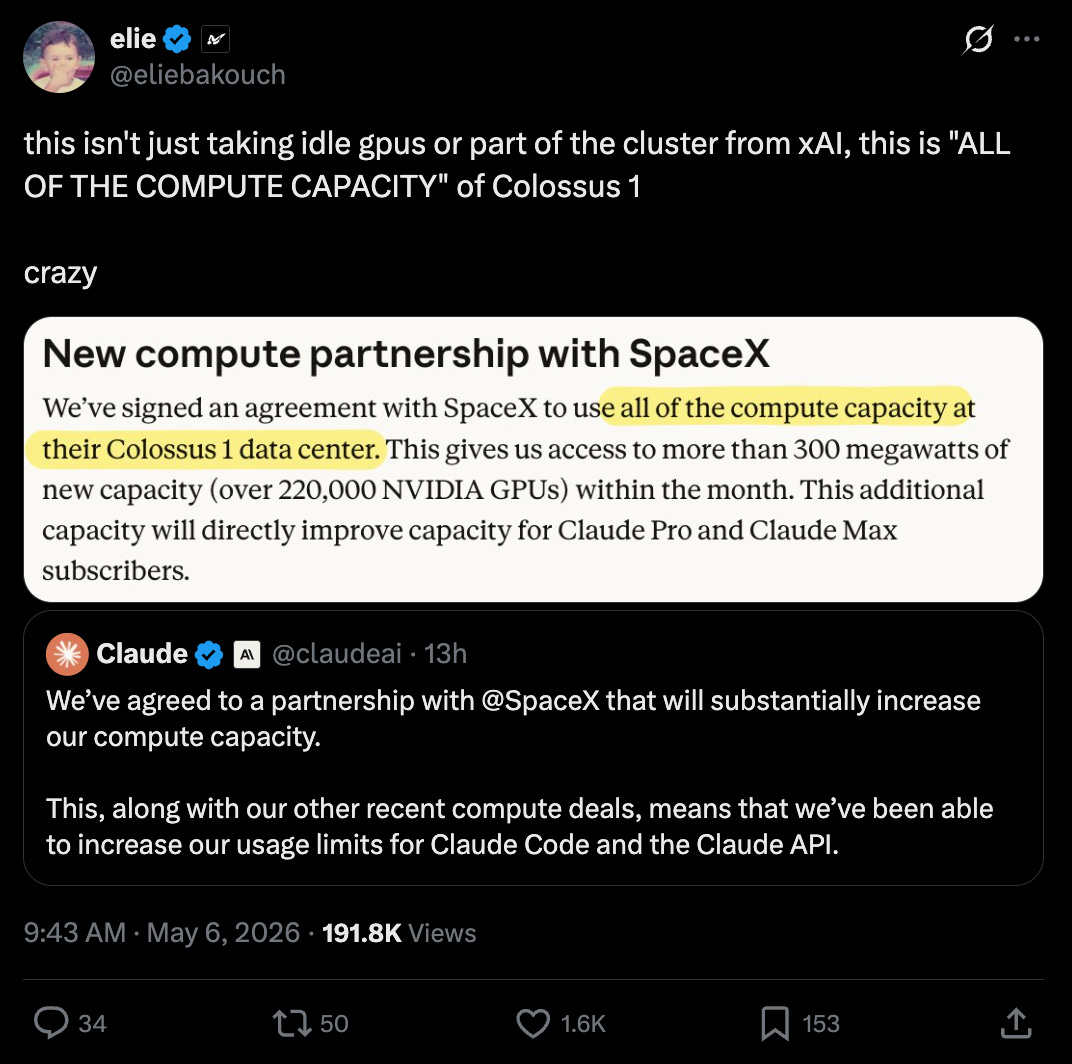
Anthropic signed a deal to access all available capacity at SpaceX's Colossus 1 facility, providing over 300 megawatts of new compute (220,000+ Nvidia GPUs) within a month, valued at approximately $5B annually. The company immediately doubled Claude Code's 5-hour rate limits for Pro, Max, and Team users and substantially increased Opus API rate limits, signaling confidence in expanded capacity. The partnership reveals that usage grew approximately 80x unexpectedly, outpacing available compute and forcing the SpaceX arrangement to address demand. This concrete metric underscores how inference capacity, not just training, has become a frontier bottleneck and demonstrates how frontier labs now rent capacity from competitors rather than relying solely on vertical integration. SpaceX and Anthropic are also exploring potential partnerships to develop multiple gigawatts of orbital AI compute capacity.
Nvidia took an equity stake in Corning and signed a multiyear deal to expand US optical connectivity manufacturing by 10x and fiber production by 50%+, with three new plants opening in North Carolina and Texas. The move mirrors Nvidia's playbook with Coherent—locking in critical supply chain partners and securing upside participation as silicon photonics becomes essential for AI data center scaling in 2027-2028.
OpenAI CEO Sam Altman stated in a Ben Thompson interview that token-based pricing doesn't make sense long-term because customers care about work completed, not token count. He noted that GPT-5.5 costs more per token but requires far fewer tokens than GPT-5.4 for equivalent output. This is significant because token pricing obscures true compute costs, creates perverse incentives for labs to inflate token counts, and prevents transparent comparison across models and providers—a shift to outcome-based or compute-normalized pricing could reshape AI economics across the industry.
Anthropic CEO Dario Amodei outlined a vision where tiny teams and individuals can build transformative AI products given model capabilities, shifting from resource accumulation to task decomposition. He described a future of "countries of geniuses in datacenters" where managed agents, memory systems ("Dreaming"), and verification tools ("Outcomes") become the next competitive layer beyond base model capability. This reflects Anthropic's strategic bet on infrastructure and tooling rather than pure model capability as the differentiator.
I read the full interview. Main takeaways:
- Microsoft and OpenAI amended their exclusive cloud deal: OpenAI can now serve all products across any cloud provider (including AWS), Microsoft remains primary partner with first access, loses revenue share payments from OpenAI, but retains non-exclusive IP license through 2032 and shareholder upside—a strategic shift driven by Anthropic's competitive threat and enterprise demand for multi-cloud access
- AWS is launching Bedrock Managed Agents powered by OpenAI, positioning it as 'Codex in AWS'—a managed agentic workflow tool that makes AI agents accessible to enterprises with existing AWS infrastructure, representing OpenAI's primary growth focus over Azure
- Sam Altman and Matt Garman draw explicit parallels between the cloud platform shift (2006) and AI adoption: both enable startups to build with less capital and faster cycles, but AI adoption is accelerating far faster than cloud did, with YC companies now expected to reach $1M+ ARR within 18 months vs. years previously
- Garman acknowledges AWS's initial AI infrastructure strategy (vertically integrated super-clusters, tight software-hardware coupling) differed from commodity compute, but emphasizes the real surprise was adoption velocity and the shift from training-era to inference-era focus
- The partnership model (OpenAI on AWS rather than full vertical integration like Google) reflects pragmatic economics: managing agents across organizations is complex; AWS's existing enterprise relationships and data residency advantages make partnership more valuable than Google's full-stack approach
I read the full report. Main takeaways:
- OpenAI published a new networking protocol called MRC (Multipath Reliable Connection) co-developed with AMD, Broadcom, Intel, Microsoft, and Nvidia that addresses GPU cluster congestion and failure modes through packet spraying and microsecond-level rerouting, already deployed in OpenAI and Microsoft's largest training clusters including Oracle Abilene and Fairwater supercomputers
- MRC uses SRv6 (IPv6 Segment Routing) to reduce network switch compute and power requirements by having data specify its own path rather than forcing switches to route, creating flatter networks that consume less data center resources
- The protocol is being released as an open standard through the Open Compute Project rather than kept proprietary, with OpenAI explicitly stating this is not a differentiation play but an effort to move the entire industry past a legacy bottleneck and prevent market fragmentation
- Network failures that previously cascaded into complete training job halts (described as failure amplifiers) are now handled transparently, allowing GPU clusters to continue training when parts of the network break down, directly accelerating research velocity
- This infrastructure work is instrumental to OpenAI's Stargate vision and addresses the imminent compute crunch by maximizing utilization efficiency of existing capacity
I read the full technical report. Main takeaways:
- Agentic workloads exhibit extreme prefix reuse: 94.2% cache hit rate on Codex/SWE-bench Pro traces with 131:1 input-to-output token ratio and contexts growing to 80K+ tokens, but only 2,242 new tokens per turn on average
- Distributed KV cache pool (Mooncake Store) integrated into vLLM achieves 3.8x throughput improvement, 46x lower TTFT, and 8.6x lower end-to-end latency on realistic agentic traces by raising cache hit rate from 1.7% to 92.2%
- Architecture uses GPUDirect RDMA for SM-free, zero-copy KV transfers between GPU HBM and CPU memory across nodes, with fully asynchronous background I/O threads to avoid blocking GPU kernel launches
- System scales nearly linearly to 60 GB200 GPUs with 95%+ cache hit rates under cross-node routing, solving the cross-instance cache miss problem that plagues isolated vLLM replicas
- MultiConnector design enables chaining of prefill-decode disaggregation with distributed KV cache pool, with future work on distributed disk offloading, cache-aware routing, and multi-path KV loading