Meta fell 10% on earnings despite strong revenue growth because it lacks enterprise cloud business to justify its ~$100B Metaverse spend, while Amazon, Microsoft, and Alphabet collectively plan to spend $700B on data centers in 2026 (up from $400B in 2025), signaling the market's skepticism about near-term returns on massive infrastructure buildout.
Microsoft now has only first refusal on OpenAI hosting rather than exclusivity, with Amazon immediately announcing it will offer ChatGPT APIs on AWS; this reflects ongoing commoditization of foundation models and OpenAI's hunger for capacity across multiple providers.
Anthropic and other model providers are moving away from flat-rate monthly pricing toward usage-based charges because agentic coding drives orders of magnitude more token use than anyone anticipated, mirroring AT&T's 2010 shift from unlimited data to capped bundles when network marginal costs became unsustainable—creating a major question for SaaS companies on whether to pass through variable costs or bundle them.
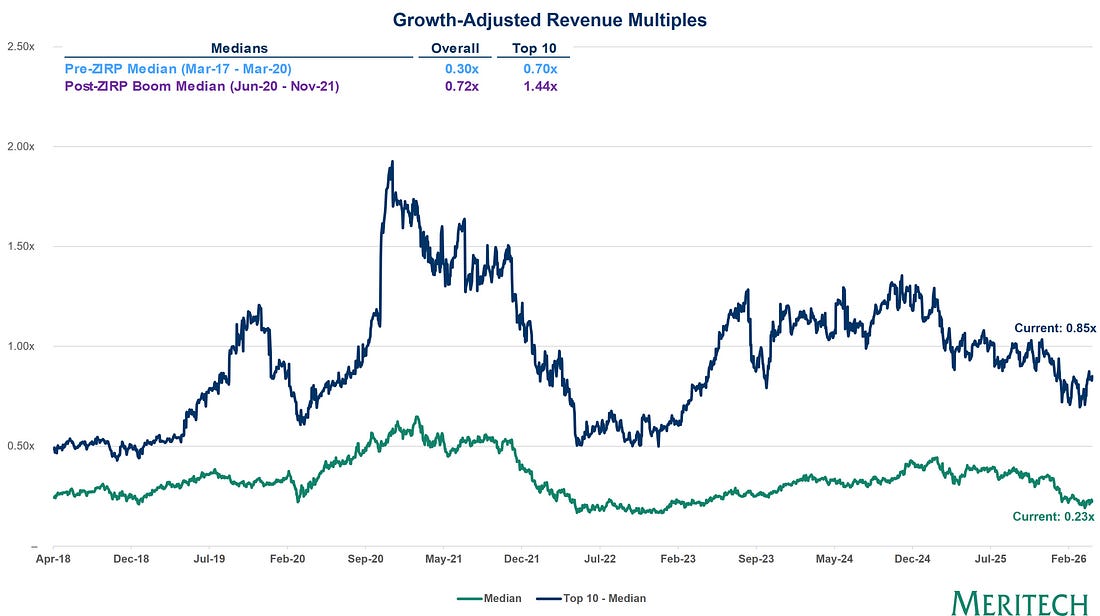
Companies with AI tailwinds (Atlassian, Crowdstrike, Datadog, Palantir, Twilio) saw 30%+ single-day pops on Q1 2026 earnings while others declined, widening the valuation gap. The median NTM revenue multiple sits at 3.3x (down 26% YTD), but growth-adjusted multiples show top 10 companies at 0.85x vs. 0.23x median, signaling market prioritizes revenue acceleration over profitability in the AI era.
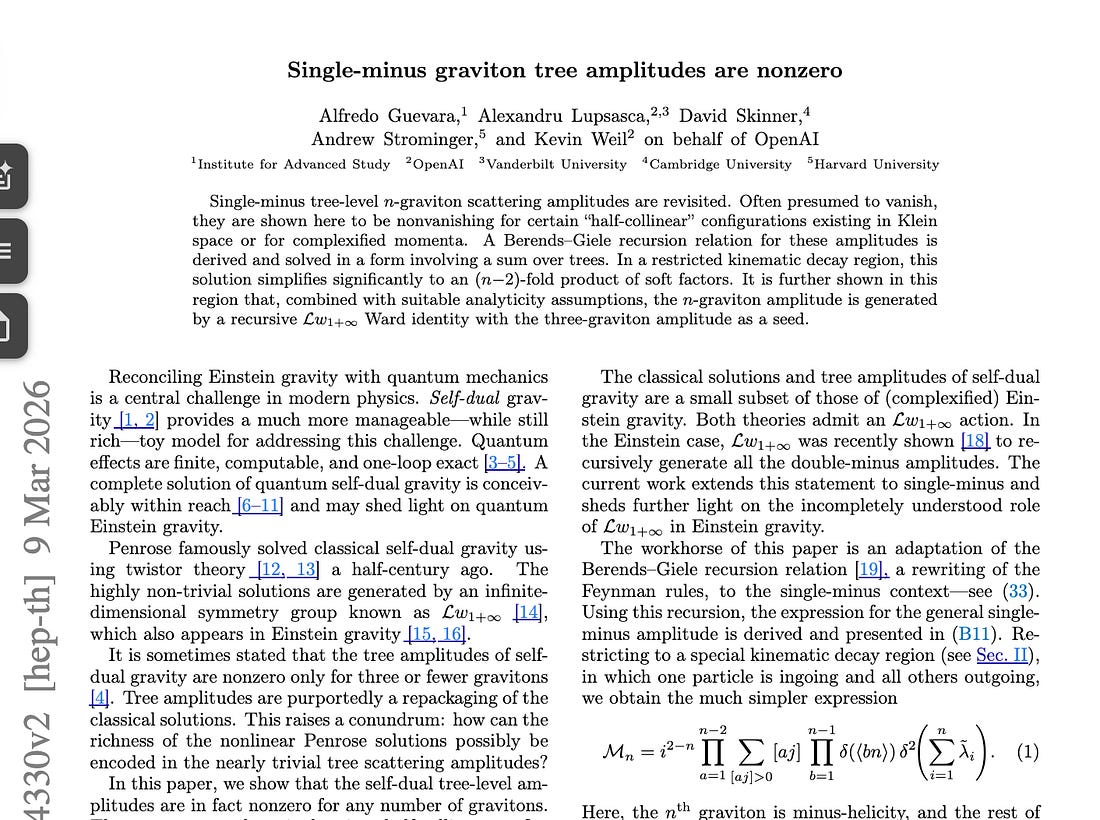
OpenAI's GPT-5.2 generated new peer-reviewed physics results on gluon tree amplitudes and graviton interactions that stumped domain experts for over a year, producing 110 pages of novel calculations and proofs in under three days using techniques unknown to the researchers. This represents a qualitative shift from AI-assisted coding to AI extending the frontier of human knowledge in out-of-domain theoretical work.
The multi-year infrastructure spend underscores both Anthropic's capital intensity and Google's emerging position as a primary compute supplier to frontier labs. This is a concrete signal of Google's competitive positioning against Nvidia in the AI infrastructure stack.
Anthropic formed a $1.5B JV with Blackstone, Hellman & Friedman, and Goldman Sachs to build Claude-powered systems for enterprises, while OpenAI's Deployment Company raised ~$4B at $10B premoney with backing from TPG, Brookfield, Advent, and Bain Capital. This signals that both labs recognize the "last mile" of getting agents into production workflows—IT modernization, context management, change management—is a distinct, high-margin business separate from model development.
Google released Gemma 4 MTP drafters promising up to 3× faster decoding with zero quality loss through speculative decoding integrated into vLLM, Transformers, SGLang, and Ollama; separately, RadixArk raised $100M around the SGLang inference stack and Miles post-training framework to make frontier-grade infrastructure open and production-grade. These moves indicate inference speed and cost optimization—not just model capability—are now critical differentiators for both open and closed ecosystems.
AWS is shifting from pure cloud provider to original equipment manufacturer, licensing or building custom silicon to compete in the infrastructure layer. This represents a structural shift in how hyperscalers compete and could reshape margins and competitive positioning across the AI stack.
I read the full post analyzing OpenAI's fundamental strategic vulnerabilities: no unique technology (half a dozen competitors ship equivalent frontier models), shallow user engagement (80% of ChatGPT users sent <1,000 messages in 2025, averaging <3 prompts/day), no durable competitive moat, and incumbents (Google, Meta) leveraging superior distribution. Evans argues the real value will come from new experiences not yet invented, which OpenAI cannot control or monopolize, and examines whether Sam Altman's recent 'platform' strategy and capex announcements represent a coherent answer to these structural problems or reactive flooding-the-zone.
I read the full Meritech Software Pulse report covering ~$3 trillion in public software market data as of May 1, 2026. The report provides concrete metrics on AI-driven valuation divergence: companies with AI tailwinds (TEAM, FIVN, TWLO, PLTR, SNOW, CRWD, DDOG, NET, PANW, SHOP) significantly outperforming those without, with median NTM revenue multiples at 3.3x overall but top 10 at 19.2x. Key finding: growth is 3.1x more correlated with valuation multiples than FCF margin, and the composition of Rule of 40 matters more than the aggregate score. Only 8 public software companies trade above 10x NTM revenue; 73% trade below 5x. Includes detailed operating metrics (NDR, payback periods, ARR per FTE) and shows Palantir commanding the widest ARR multiple spread ever relative to median company.
I read the full OpenAI research announcement describing how GPT-5.2 conjectured a previously unknown formula for gluon tree amplitudes in theoretical physics, which was then formally proven by an internal scaffolded model and verified analytically by human physicists. The work demonstrates concrete AI-assisted scientific discovery: GPT-5.2 Pro reduced superexponentially complex Feynman diagram expressions to simple closed forms, identified a pattern across base cases, and posited a general formula that an internal model then proved rigorously—a methodologically significant example of LLM-human collaboration in frontier physics research with endorsements from leading theoretical physicists.
I read Anthropic's announcement of a new enterprise AI services company backed by Blackstone, H&F, Goldman Sachs, and a consortium including Sequoia and General Atlantic. The post details a significant go-to-market strategy shift: Anthropic is building dedicated delivery capacity for mid-market companies (community banks, regional manufacturers, health systems) that lack in-house resources for frontier AI deployment, with Applied AI engineers embedded alongside customer engineering teams. This represents concrete product strategy and infrastructure buildout for Claude adoption beyond large enterprises already served by systems integrators.
I read the full technical deep dive on Broadcom's 3.5D XDSiP chiplet stacking technology and its adoption across the AI infrastructure stack. The article provides concrete technical comparisons (14,000 signals per mm² vs 1,500 for face-to-back approaches), specific customer implementations (Fujitsu's Monaka with 2nm/5nm stacking, six unnamed XPU makers including likely AWS Trainium4 and Meta MTIA 500), power efficiency gains (0.2 picojoules per bit vs 3-5 for off-chip links), and a timeline showing at least one customer shipping in H2 2026. This is directly relevant to understanding competitive positioning in AI accelerator design and manufacturing economics.